A call whisper example is a short, agent-only message or screen pop that delivers caller context before or during a call, letting staff personalise service, coach live, and cut missed outcomes. It comes in two forms: a pre-call data whisper (played or shown before the agent connects) and a live supervisor whisper (spoken during the call, heard only by the agent). Service and hospitality teams use both to speed up booking and dispatch, lift first-call resolution (FCR), and make repeat callers feel remembered.
- Pre-call whisper: reservation details, campaign source, or VIP flags surface before "hello"
- Live whisper: a supervisor coaches an agent mid-call without the caller hearing
- Below: ready scripts, a build path, and a pilot checklist to test it in weeks, not months
Key Takeaways
Effective call whisper programs succeed by pairing short, data-driven scripts with disciplined privacy rules and a measured pilot before any wider rollout.
| Point | Details |
|---|---|
| Definition matters | A call whisper example is a private, agent-only message or screen pop delivered before or during a call. |
| Two core variants | Pre-call whispers set up the greeting; live whispers let supervisors coach without the caller hearing. |
| Scripts must stay short | Keep spoken whispers under ten seconds and move sensitive fields to screen-pop instead of audio. |
| Measure before scaling | Track FCR, CSAT, AHT, and missed-call rate across a four-week pilot with a control group. |
| Dexcoretechnologies as the scale path | Its AI receptionist automates caller context capture and booking around the clock, extending whisper-style personalisation beyond live agent hours. |
Table of Contents
- What is call whisper and how does it differ from monitoring?
- Ready-to-use call whisper examples and scripts
- How to build call whisper into your phone system
- Wording, timing, and privacy rules that actually hold up
- Measuring whether call whisper is actually working
- A 2 to 4 week pilot checklist you can run this month
- Call whisper examples for service teams: what actually moves the needle
- Scaling whisper-level context without a live supervisor on every call
- Sources
What is call whisper and how does it differ from monitoring?
Call whisper plays private information to an agent, by voice or screen pop, right before or during a call. Picture a hostess line where the screen flashes "party of 6, birthday, requested patio" a half second before the phone rings through. That is the whole idea in one sentence.
Two variants matter most for service and hospitality teams:
- Pre-call whisper. A message or on-screen note fires the instant the call routes to an agent, based on caller ID, the number dialled, or a CRM lookup.
- Live whisper. A supervisor speaks into an active call, audible only to the agent, typically for coaching or an escalation nudge.
Dynamic whispers add another layer: content that changes per call, pulled from IVR selections, the number a customer dialled, or CRM records, so the same whisper system tells one agent "campaign: spring promo" and another "returning customer, third visit this month." Whisper is not monitoring or barging, which involve listening in or joining the call outright. Whisper stays one-way and invisible to the caller.
Ready-to-use call whisper examples and scripts
Copy these directly and adjust the bracketed fields for your booking system or CRM. Each one is built for speed, since a whisper that takes ten seconds to process defeats the purpose.
Pre-call whisper templates:
- Reservation lookup: "Reservation for [Name], party of [X], [time]. Special request: [note]."
- Campaign tracking: "Caller dialled the [Spring Promo] line. Offer: [10% off patio bookings]."
- VIP or returning customer: "Returning guest, [Name], [X] visits. Last order: [item]. Loyalty tier: [gold]."
- Appointment confirmation: "Confirming [service] at [time] with [staff name]. Vehicle/pet/patient: [detail]."
Live whisper coaching lines (supervisor to agent, mid-call):
- Escalation cue: "Offer the manager callback option now."
- Upsell nudge: "Mention the seasonal package before you close."
- Compliance prompt: "Confirm cancellation policy before booking."
- De-escalation cue: "Slow down, acknowledge the wait time first."
Each template earns its place for a specific reason. The reservation lookup shortens the opening ten seconds of a hostess call, which Getvoip is where callers judge whether a business "knows" them. The campaign-tracking whisper doubles as a rough marketing measurement tool, since agents can log which line drove the call. The VIP whisper drives what one industry breakdown calls personalisation at scale: a returning customer hears their history acknowledged in the first sentence rather than the fifth. Live coaching lines exist because supervisor whispering reduces agent anxiety and speeds on-the-job training without the customer ever knowing a second person is involved.
One-line edit rule for all of them: if a whisper takes longer to read than the greeting it precedes, cut it. Screen pops can hold more text than a spoken cue.
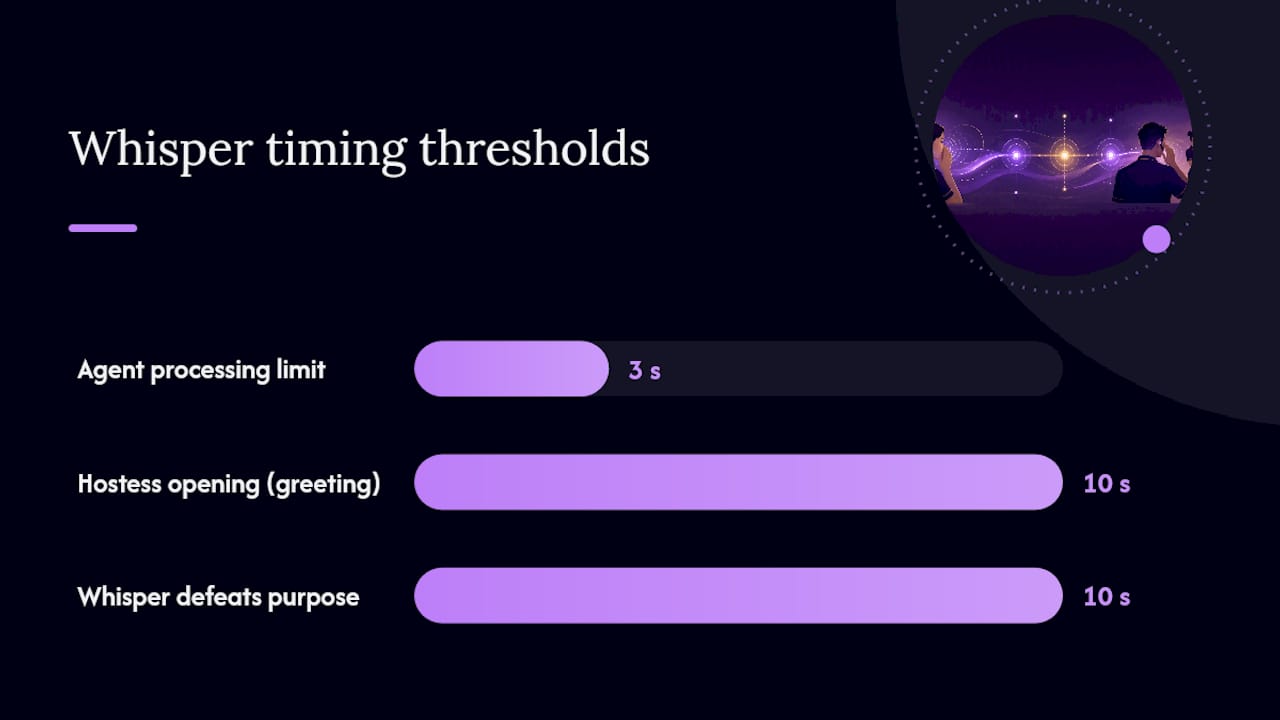
Pro Tip: Write whisper scripts at a fifth-grade reading level and test them out loud with a stopwatch. If an agent can't process it in under three seconds, it's too long for a live call.
How to build call whisper into your phone system
Three implementation paths cover most service and hospitality setups, ranging from a weekend fix to a developer project.
- Cloud PBX / hosted telephony. Most hosted phone providers include a whisper setting inside call routing rules. You assign a message or short audio clip to a number or extension, and it plays automatically when the call connects. This is the fastest path if you already run a cloud phone system.
- Voice API approach. For custom logic, developers use voice APIs and webhooks: an incoming call triggers a webhook, the application checks caller ID or a CRM field, then a text-to-speech (TTS) or "speak" action plays the whisper before bridging the call. Sample projects demonstrate this exact sequence using call events and speak actions, and community examples show a similar pattern with two phone numbers and a webhook handler for local testing.
- CRM screen-pop. Instead of audio, the caller's record pops on screen the moment the phone rings, pulled from CRM integrations. This keeps sensitive fields out of spoken audio entirely.
Minimal pilot checklist:
- Pick one phone number or extension to test on
- Draft two or three whisper messages tied to real call types
- Confirm routing rules trigger the whisper correctly before go-live
- Run five test calls internally before opening to real traffic
Wording, timing, and privacy rules that actually hold up
A whisper only works if it disappears into the workflow. Keep every spoken whisper under ten seconds, built from caller intent and booking details rather than generic filler. Anything longer forces the agent to choose between listening and reading.
- Use screen-pops, not spoken TTS, for anything sensitive: medical notes, payment details, or account numbers
- Never read personal health or financial data aloud, even to an agent only, since call recordings can capture it
- Set a written policy on when supervisors are allowed to live-whisper, and log each coaching instance
- Train agents to act on a whisper without pausing, then confirm the action back to the caller within one sentence
Cloud platforms typically bundle whisper alongside call monitoring and barging in the same settings panel, so misconfiguration is a real risk if no one reviews permissions regularly. Decide who can trigger a live whisper, document it, and revisit the policy quarterly, particularly if your business handles health, financial, or child-related bookings under Canadian privacy obligations.
Pro Tip: Run a monthly five-minute audit of who has live-whisper access. Turnover means an ex-employee's supervisor permissions often outlive their employment by months.
Measuring whether call whisper is actually working
Track five numbers before and after rollout: first-call resolution (FCR), customer satisfaction (CSAT), average handle time (AHT), missed-call rate, and booking or dispatch conversion. A whisper that shortens handle time but tanks CSAT is not a win.
- Run a four-week pilot with a control group of agents who don't receive whispers
- Compare FCR and booking conversion between the two groups weekly, not just at the end
- Use call recordings alongside a whisper log to see which scripts agents actually acted on versus ignored
- Reducing missed calls is usually the fastest metric to move, since context lets agents close bookings on the first attempt
Supervisor whisper coaching, applied consistently during the pilot, tends to shorten new-agent ramp time because feedback lands in the moment rather than in a review a week later, a pattern documented across sales, healthcare, and hospitality call centres.
A 2 to 4 week pilot checklist you can run this month
Rolling out call whisper doesn't need a committee. Here's the order that avoids the usual stalls:
- Pick one or two phone numbers to route through the pilot
- Write three whisper messages: one reservation lookup, one VIP flag, one campaign tag
- Set the routing rule so the correct whisper fires per number or CRM match, following the same logic as service call routing
- Train two agents and one supervisor on when and how to use live coaching whispers
- Run 20 to 30 supervised test calls and log FCR, handle time, and agent feedback on a simple capture form
- Review results after two weeks; extend to more lines only if FCR or conversion improved
Common pitfall: whispers that arrive too late because the CRM lookup is slow. Fix it by caching frequent caller data rather than querying live on every ring.
Call whisper examples for service teams: what actually moves the needle
The mistake most operators make with call whisper is treating it as a scripting exercise, when it's really a data problem. A whisper is only as good as the lookup behind it, and most businesses underinvest in the CRM or booking system that feeds it, then wonder why the "personalised" whisper reads the same generic line to every caller.
Conventional advice leans hard on scripting: write better whisper lines, train agents harder. That's backwards. A supervisor whisper coaching a struggling agent through a fifth call of the day matters less than making sure the first whisper that agent hears is actually correct. Bad data whispered confidently is worse than no whisper at all, since it erodes agent trust in the system within a week.
If you're prioritizing anything first, it's the data pipeline: get caller ID, campaign source, and booking history flowing reliably before you touch script wording. Multilingual callers deserve the same rigour. Pairing whisper with real-time language support closes a gap most Canadian service businesses haven't even considered yet.
— James
Scaling whisper-level context without a live supervisor on every call
Call whisper works because it hands an agent context at exactly the right second. The catch is that it depends on a human being available to hear it, and most service and hospitality lines miss calls entirely outside business hours or during peak rushes. Dexcoretechnologies runs on the same principle, minus that dependency: an AI receptionist that answers every call, pulls caller context automatically, and books the appointment or reservation without waiting for an agent to be free.
Dexcoretechnologies connects to your CRM, calendar, and POS the way a whisper system connects to caller data, except it acts on that context directly rather than just displaying it. It answers 24/7, sends SMS confirmations, notifies your team, and routes requests, capturing the same operational value a well-built whisper program aims for, but without a missed call ever slipping through. If your team already has whisper scripts drafted, the next step is booking a pilot for your service business or checking the restaurant-specific setup to see how it fits your call volume.
Sources
- Call whisper
- What is Call Whisper? How it Works & Top Benefits
- What is Call Whisper? How It Works & Why It Matters