
Prioritise three things this week: deflect repeat questions before the call reaches an agent, route what remains by intent, and give agents a live AI copilot during the call. Keep a visible, one-press path to a human at every step. That combination, piloted over six to eight weeks, is the fastest route to measurable gains in first-call resolution (FCR) and customer satisfaction (CSAT).
Start here:
- Measure your current missed-call rate from your phone system logs (today).
- Add a prominent callback or SMS option so callers are never stranded on hold.
- Publish or update your top 10 knowledge-base articles so AI suggestions have something reliable to surface.
According to Sangoma, 67% of customers have hung up out of frustration when they could not reach a real person. That single figure tells you where the revenue is leaking. Dexcoretechnologies's AI receptionist and workflow automation platform is built to close exactly that gap, with 24/7 answering, intelligent routing, and CRM integrations that work from day one.
Key takeaways
The fastest way to improve phone customer experience is to deflect repeat questions before the call, route what remains by intent, and give agents live AI assistance during the call while keeping a one-press path to a human at every stage.
| Point | Details |
|---|---|
| Audit before you automate | Pull two to four weeks of call logs and tag calls as automatable or human-required before changing anything. |
| Deflection beats voicebots | Deflecting repeat questions to self-service resolves more volume faster than deploying a full conversational voicebot. |
| Knowledge base first | AI suggestions only work reliably when your top 20 articles are accurate, tagged, and up to date. |
| Six-to-twelve-week pilot | Set two to three measurable success criteria before week one and make expansion conditional on hitting them. |
| Dexcoretechnologies fits the full plan | 24/7 AI receptionist, routing, SMS confirmations, and CRM integrations cover every pilot phase from deflection to after-call automation. |
Table of Contents
- How do you audit your phone customer experience quickly?
- What are the quickest wins to reduce missed calls and speed up resolution?
- How do you balance automation with human empathy on the phone?
- What integrations does a reliable phone CX setup actually need?
- What does a realistic pilot plan look like?
- How do you measure ROI and keep improving after the pilot?
- How should you train and coach phone agents to lift call quality?
- How do you handle difficult or escalated calls without losing the customer?
- What personalization techniques actually move the needle on phone CX?
- Why the automation-first pilot that keeps humans central is the right call
- Dexcoretechnologies covers the full pilot from day one
- Sources
How do you audit your phone customer experience quickly?
Before you change anything, you need a two-to-four-week baseline. Pull call logs from your phone system, export helpdesk tickets, and run a short post-call survey. The table below covers the six metrics that matter most and how to collect each one.
| Metric | What it measures | How to collect it |
|---|---|---|
| Missed-call rate | Calls that ring out or go to voicemail | Phone system logs |
| Abandonment rate | Callers who hang up before an agent answers | Queue/IVR reports |
| Average handle time (AHT) | Total time per call including wrap-up | Helpdesk or phone platform |
| First-call resolution (FCR) | Issues resolved without a callback | Helpdesk tickets + agent tags |
| CSAT / NPS | Caller satisfaction after the interaction | Post-call SMS or IVR survey |
| Repeat contacts | Same caller, same issue, within seven days | CRM contact history |
IBM's guidance on call centre improvement frames measurement as a balance between efficiency KPIs (AHT, FCR) and loyalty metrics (CSAT, NPS). Collect both from the start or you will optimise speed at the expense of satisfaction.
Once you have the numbers, tag a sample of 20–50 call transcripts by category: order status, hours and location, basic policy, billing disputes, and cancellations. The first three are usually automatable. The last two almost always need a human.
Pro Tip: Combine queue stats with transcript sampling. Quantitative data tells you how many calls are a problem; transcripts tell you why. Without both, you will automate the wrong things.
What are the quickest wins to reduce missed calls and speed up resolution?
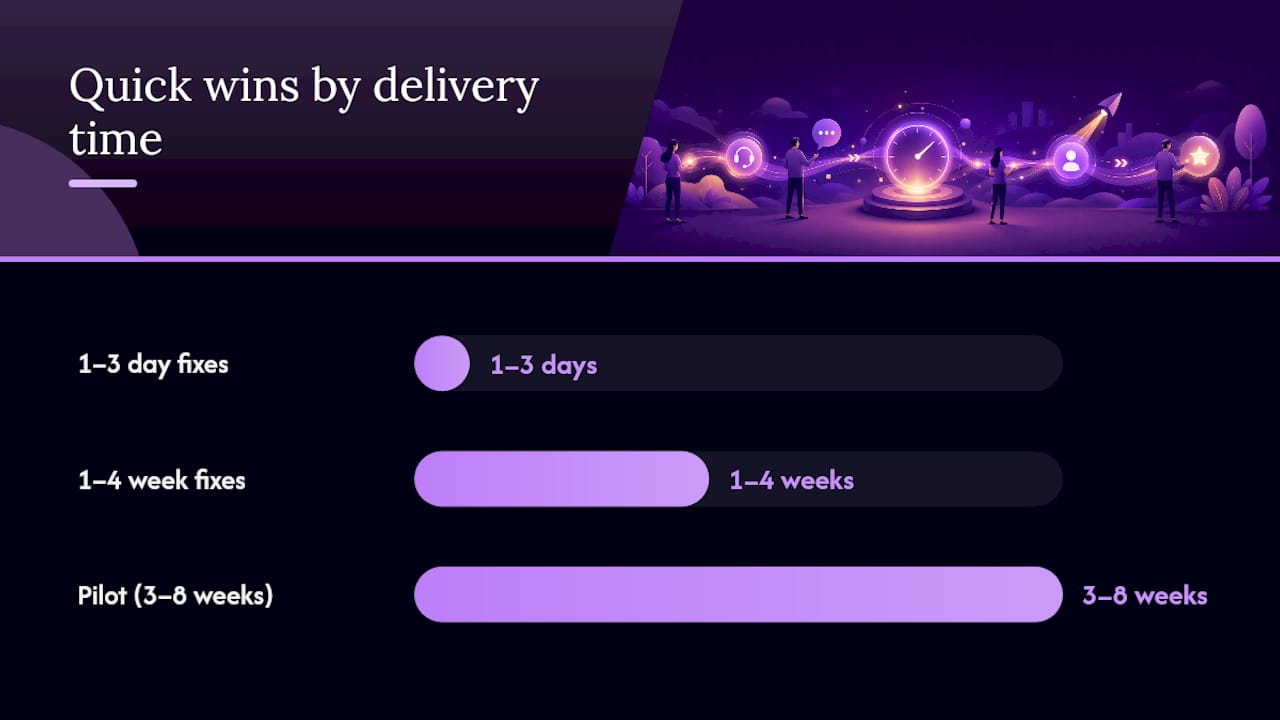
Rank your fixes by how fast they deliver value, not by how impressive they sound.
1–3 day fixes:
- Enable a callback or SMS option in your phone system so callers do not wait on hold.
- Fix your top 10 knowledge-base articles (the ones agents look up most often).
- Shorten your IVR menu to three options or fewer; add a "press 0 for a person" escape at every level.
1–4 week fixes:
- Set up intent-based routing so callers who say "book an appointment" go directly to scheduling, not a general queue.
- Add SMS confirmations for bookings and follow-ups to reduce inbound "did my appointment go through?" calls.
- Deploy digital self-service for repeat questions like hours, location, and order status. TechTarget notes that well-designed digital deflection often outperforms IVR self-service in completion rates.
Pilot-level changes (weeks 3–8):
- Introduce an AI agent copilot that transcribes calls live and surfaces relevant knowledge-base answers in real time.
- Automate after-call admin: summaries, ticket creation, and follow-up messages.
Pro Tip: Do not deploy deflection until your help centre can actually answer the questions you are deflecting. An AI that confidently surfaces a wrong or outdated article is worse than no AI at all.
Eesel AI's automation guide reports that teams applying deflection and after-call automation resolved up to 73% of tier-1 requests in the first month. Voicebots, by contrast, tend to be the smallest win in the stack.
How do you balance automation with human empathy on the phone?
Think in four layers, applied in sequence.
- Deflection before the call: FAQ pages, SMS self-service, and a well-structured help centre handle repeat questions before a caller ever dials.
- Intent routing at call start: Natural-language IVR captures the caller's reason in their own words and routes to the right queue or self-service flow immediately.
- AI agent copilot during the call: The system transcribes the conversation live, searches the knowledge base, and surfaces suggested answers the agent can accept, modify, or dismiss. Zendesk's real-time AI suggestions feature works exactly this way, with agents upvoting or downvoting suggestions to improve the model over time.
- After-call automation: Auto-generated call summaries, ticket creation, and follow-up SMS messages cut wrap-up time and keep records consistent.
For the human escape hatch, the rule is simple: one keypress, always available, never buried. Route to a human whenever the AI confidence score drops below your threshold, the topic involves billing or safety, or the caller explicitly asks.
Knowledge-base readiness checklist before you go live:
- Top 20 questions answered with canonical, single-version responses.
- Each article tagged with intent keywords so the search API can find it.
- Outdated articles archived, not just unpublished.
- A named owner responsible for monthly article reviews.
Operationally, restrict AI suggestion access by agent group during the pilot. Require agents to upvote or downvote every suggestion for the first 30–60 days. That feedback loop is what turns a generic model into one that knows your business.
What integrations does a reliable phone CX setup actually need?
Must-have integrations and features:
- Call transcription (real-time and post-call)
- CRM integration for unified customer profiles
- Helpdesk ticketing connected to call outcomes
- Knowledge-base search API for live agent suggestions
- SMS gateway for confirmations and follow-ups
- Queue and analytics reporting dashboard
- Call recording with consent handling built in
Deployment readiness checklist:
- Test data flows end-to-end before go-live (call → transcript → CRM record → ticket).
- Confirm a unified customer profile exists so agents see history without asking callers to repeat themselves.
- Build a backup routing rule for system outages so calls never go unanswered.
- Set up real-time dashboards for missed-call trends, queue health, and agent-assist uptake.
On privacy: place a brief disclosure at the start of every call ("This call may be recorded and AI-assisted for quality purposes") and confirm your province's consent requirements with a qualified legal adviser before recording goes live.
What does a realistic pilot plan look like?
| Week | Milestone | Owner |
|---|---|---|
| 1–2 | Baseline audit: export logs, tag calls, run transcript sample | Operations manager |
| 3–4 | Fix top 10 KB articles; shorten IVR; enable callback option | IT/Dev + frontline supervisor |
| 3–4 | Deploy intent routing and SMS confirmations; test data flows | IT/Dev + vendor contact |
| 7–8 | Launch agent copilot with a small group (10 agents) | Frontline supervisor + vendor |
| 7–8 | Measure FCR, CSAT, AHT, and missed-call rate vs. baseline | Operations manager |
| — | Go/no-go decision; plan phased expansion | Leadership + operations |
Budget line items to plan for:
- Platform licence or subscription (weekly, monthly, or pay-per-use depending on your vendor).
- Onboarding and integration setup (often included in managed service packages).
- Staff hours for knowledge-base work and training (budget 10–20 hours in weeks 1–4).
- Optional professional services for custom workflow design.
Set your pilot success criteria before week one: for example, reduce missed calls by 20%, lift CSAT by five points, and cut after-call admin time by 30%. A phased expansion only triggers when at least two of three criteria are met.
How do you measure ROI and keep improving after the pilot?
Primary KPIs to track weekly:
- Missed-call rate and abandonment rate
- Average handle time (AHT)
- First-call resolution (FCR)
- CSAT and NPS scores
Secondary KPIs to track monthly:
- Agent-assist adoption rate (what percentage of suggestions are used)
- Upvote/downvote ratio by article (flags knowledge-base gaps)
- Repeat contact rate (same issue, same caller, within seven days)
Run a daily queue health check, a weekly pilot review with frontline supervisors, and a monthly ROI assessment comparing licence cost against admin hours saved and calls contained.
Pro Tip: Pair your dashboard numbers with a monthly listen-back session: pull five to ten calls where CSAT scored low and listen for empathy gaps, not just process failures. Quantitative data tells you a problem exists; the recording tells you what it felt like to the caller.
Governance matters as much as measurement. Assign one person to review AI suggestion quality weekly, define escalation criteria in writing, and feed agent coaching sessions with assist analytics rather than gut feel.
How should you train and coach phone agents to lift call quality?
The biggest gap in most agent training programmes is context. Zendesk's research found that having customer context at agents' fingertips is one of the highest-impact etiquette improvements available, yet most businesses still ask callers to repeat their account details after being transferred.
Effective coaching combines three inputs: call recordings, AI-assist analytics, and live observation. Use recordings to identify where agents talk over callers or miss a resolution opportunity. Use assist analytics to see which suggested answers agents consistently reject, which often signals a script or knowledge-base problem rather than an agent problem. Live observation, even one call per agent per week, catches tone and pacing issues that transcripts miss.
Build a short call-quality scorecard (five to eight criteria: greeting, empathy acknowledgement, resolution accuracy, hold communication, wrap-up) and review it in weekly one-on-ones. Agents improve faster when feedback is specific and tied to a real call they remember.
How do you handle difficult or escalated calls without losing the customer?
The first 30 seconds of a difficult call usually determine the outcome. Agents who acknowledge the caller's frustration before attempting a solution de-escalate faster than those who jump straight to troubleshooting. A simple phrase like "I can see why that's frustrating, let me pull up your account right now" costs nothing and buys the agent time to find the answer.

Define your escalation criteria in writing: billing disputes above a set threshold, safety concerns, repeat contacts on the same unresolved issue, and any caller who explicitly requests a supervisor. Agents should never have to guess whether to escalate.
For calls that cannot be resolved in one interaction, close with a specific commitment: a named follow-up date, a ticket number the caller can reference, and an SMS confirmation sent before the call ends. Vague promises ("someone will get back to you") are the single biggest driver of repeat contacts.
What personalization techniques actually move the needle on phone CX?
Personalization on a phone call is not about using the caller's first name. It is about not making them repeat themselves. When your CRM surfaces the caller's last interaction, open order, or appointment history before the agent picks up, the conversation starts three steps ahead.
Practical techniques worth implementing:
- Screen pop on inbound calls: CRM data appears on the agent's screen the moment the call connects, showing name, account status, and last contact reason.
- Proactive SMS before the call: For appointment-driven businesses, a reminder sent 24 hours before reduces no-shows and eliminates a category of inbound calls entirely.
- Post-call follow-up by channel preference: Some callers prefer a text summary; others want an email. Capture the preference once and automate accordingly.
For service businesses using an AI receptionist, these personalization layers are built into the workflow rather than bolted on manually, which means they work consistently at 2 AM as reliably as at 2 PM.
Why the automation-first pilot that keeps humans central is the right call
The conventional advice on phone CX improvement tends to split into two camps: "automate everything" or "humans are irreplaceable." Both miss the point. The evidence in this article points to a third path: automate the tasks that do not require judgment (deflection, routing, after-call admin), and use AI to make human agents faster and more confident on the calls that do.
Dexcoretechnologies's 24/7 AI receptionist and workflow automation platform is built around exactly this model.
The governance piece is the part most pilots skip. Require agent sign-off on AI-suggested answers for the first 30–60 days. It feels slower, but it builds the training data and agent trust that make the system genuinely useful at month three rather than quietly ignored.
Dexcoretechnologies covers the full pilot from day one
Missed calls are lost revenue, and most businesses do not know how many they are losing until they look at the logs. Dexcoretechnologies gives you 24/7 AI call answering, intelligent missed-call handling, appointment booking automation, and CRM and calendar integrations that work from the first week of your pilot, not after a six-month implementation.
The platform handles every phase of the playbook above: deflection and SMS confirmations in weeks one through four, agent copilot and after-call automation in weeks five through eight, and full workflow automation for restaurants, clinics, contractors, and service businesses as you scale. Onboarding includes professional setup, integration support, and training so your team is not left to figure it out alone.
Book a demo or start a trial at Dexcoretechnologies and see what your missed-call rate looks like after 30 days.
Sources
- How to Improve Call Center Customer Service | IBM
- 3 Ways to Improve Customer Experience Over the Phone - Sangoma Technologies