
An AI receptionist captures every inbound call, books appointments in real time, qualifies leads, and handles routine inquiries around the clock, all without adding headcount. For a small or growing Canadian business, that translates directly into fewer missed opportunities, lower front-desk costs, and faster response times for customers. Research shows 77% of customers expect to reach someone immediately when they contact a business, a bar that a single human receptionist working 9-to-5 simply cannot meet consistently. The recommended starting point: run a 30-day pilot scoped to after-hours and peak-hour coverage, where missed calls are most costly and the ROI case is easiest to prove.
The term "AI receptionist" is the common shorthand. The industry term is intelligent virtual agent (IVA), a software system that combines speech recognition, natural language understanding, and dialogue management to handle caller interactions autonomously. Both terms appear throughout this guide.
Quick facts:
- AI answering services qualify leads, schedule appointments, answer FAQs, and integrate with business tools to support operations 24 hours a day without proportional payroll increases.
- Intelligent routing powered by natural language understanding can improve first-call resolution by up to 22%, reducing repeat calls and lifting customer satisfaction.
- Dexcoretechnologies offers a Canadian-ready AI receptionist with 24/7 answering, calendar and CRM integrations, and industry templates built for restaurants, clinics, contractors, and service businesses.
Key takeaways
AI receptionists deliver the clearest ROI for Canadian small businesses when deployed first in the highest-loss call window, typically after hours or during peak periods, with scripts built from real call data and a defined human escalation path.
| Point | Details |
|---|---|
| 24/7 answering closes the gap | 77% of customers expect immediate contact; an AI agent meets that expectation at all hours. |
| ROI comes from recovered leads | Model calls answered, conversion rate, and average sale value to build the internal business case. |
| Integrations drive the fastest return | Calendar and CRM sync deliver the quickest measurable ROI for appointment-driven businesses. |
| PIPEDA compliance is your responsibility | Ask vendors about Canadian data residency and get the answer in writing before go-live. |
| Dexcoretechnologies is a Canadian-ready option | Offers 24/7 answering, industry templates, and PIPEDA-aware onboarding for small and growing businesses. |
Table of Contents
- The top AI receptionist benefits at a glance
- How each benefit affects your operations, revenue, and customers
- How an AI receptionist actually works
- What to expect for setup, timeline, and pricing in Canada
- Practical examples by industry
- Evidence, ROI signals, and what Canadian businesses can realistically expect
- How to decide and run a 30-day pilot
- The case for AI receptionists is strong, but the implementation details are where it gets decided
- Dexcoretechnologies: a Canadian-ready AI receptionist built for your industry
- Sources
The top AI receptionist benefits at a glance
For a busy owner who needs the short version before diving deeper, these are the benefits that move the needle most for small and growing businesses:
- Never miss a call. Every inbound call is answered instantly, even during lunch, after hours, or when all staff are occupied.
- 24/7 availability. Customers in any time zone reach a live-sounding agent at 2 AM on a Sunday, not a voicemail box.
- Automated appointment booking. The system checks calendar availability and confirms bookings in real time, eliminating phone tag.
- Lead qualification. The agent collects caller details, identifies intent, and routes hot leads to the right person immediately.
- Predictable costs. A subscription or per-call model replaces variable payroll, overtime, and sick-day coverage.
- Consistent brand experience. Every caller hears the same greeting, the same script, and the same tone, regardless of call volume.
- Scalability. The system handles unlimited concurrent calls during a marketing push or seasonal peak without adding staff.
- Staff redeployment. Front-desk time shifts from answering phones to serving customers who are already in the room.
Pro Tip: Start the pilot during your highest-loss window, typically after hours or the lunch rush, and track one KPI: calls answered versus calls previously missed. That single number makes the ROI case internally.
How each benefit affects your operations, revenue, and customers
Never miss a call and capture every lead
A missed call from a new customer is rarely a second chance. Most callers move to the next result rather than leave a voicemail. An AI receptionist answers instantly, gathers the caller's name, number, and reason for calling, and either books them directly or sends the lead to your CRM for follow-up. The mechanics matter: the system logs the call, fires an SMS to the caller confirming next steps, and notifies the relevant staff member, all within seconds of the call ending.
24/7 availability and multilingual support
Immediate response is now the baseline, not a differentiator. An AI receptionist meets that expectation at 3 AM on a holiday without overtime pay. Multilingual support, available in many platforms including Dexcoretechnologies, means a Francophone caller in Québec or a Mandarin-speaking customer in Vancouver gets served in their preferred language without transferring to a specialist.
Appointment scheduling and calendar integration
Real-time booking is where the operational impact is most visible. The agent queries your calendar, confirms an open slot, books it, and sends an SMS confirmation, all within the call. Integrations with Google Calendar, Microsoft 365, and common CRMs prevent double-booking and eliminate the back-and-forth that consumes front-desk time. Reminder messages reduce no-shows, which is a measurable revenue recovery for any appointment-driven business.
Cost savings and ROI
Replacing receptionist payroll with an AI solution can cut front-desk operating costs substantially. A full-time receptionist in Canada carries salary, CPP contributions, EI premiums, benefits, and training costs. Subscription-based AI services typically run on a fraction of that, with pricing that scales by call volume rather than by headcount. The ROI case strengthens further when you factor in recovered leads: a single converted customer per week, at an average sale value of a few hundred dollars, often covers the monthly subscription on its own.
Improved customer experience and fewer errors
Human receptionists have good days and bad days. Scripts drift, names get misspelled, and details get missed during a busy Friday afternoon. An AI agent delivers the same greeting, collects the same fields, and routes the call the same way every single time. AI receptionists handle unlimited concurrent calls with no hold time, which matters most during peak periods when a human would be putting callers on hold or rushing through intake.
Integrations and workflow automation
The value of an AI receptionist multiplies when it connects to the tools you already use. Practical integration points include CRM webhooks (so every call creates or updates a contact record), calendar APIs for live booking, POS systems for order-linked calls, dispatch platforms for trades businesses, and SMS gateways for confirmations and reminders. Market reviews consistently identify integrations and scheduling as the features that deliver the fastest ROI for appointment-driven businesses.
Scalability and staff impact
A human receptionist has a hard ceiling: one call at a time. An AI agent has no such limit. During a promotional campaign or a seasonal spike, the system absorbs the volume without degrading service. Staff freed from call-answering duties shift to tasks that require human judgment: in-person customer service, complex problem-solving, and relationship management. That redeployment is often where the softer ROI lives, in higher customer retention and better in-person experiences.
Limitations and how to handle them
No AI agent handles every call perfectly. Complex complaints, emotionally distressed callers, and nuanced clinical or legal inquiries need a human. A well-designed call flow includes a clear escalation path: the agent detects frustration signals or an out-of-scope request and performs a warm transfer to a live staff member, passing along the call summary so the caller does not have to repeat themselves. On the compliance side, Canadian businesses handling personal health information must align with PIPEDA, and any vendor you evaluate should be able to speak clearly to data residency and access controls. Spam and robocall detection is a standard feature in most platforms and reduces wasted agent minutes.
| Benefit | Primary impact | Key metric to track |
|---|---|---|
| 24/7 call answering | Zero missed calls after hours | Calls answered rate |
| Automated booking | Fewer no-shows, no double-bookings | Appointments booked per week |
| Lead qualification | Faster follow-up, higher conversion | Qualified leads captured |
| Cost predictability | Lower front-desk operating cost | Monthly cost vs. payroll baseline |
| First-call resolution | Fewer repeat calls, higher satisfaction | Resolution rate per call |
| Concurrent call handling | No hold times during peaks | Average wait time |
How an AI receptionist actually works
At its core, an AI receptionist is a dialogue system built on four components working in sequence: speech recognition converts the caller's voice to text, natural language understanding (NLU) identifies the intent behind the words, a dialogue manager selects the appropriate response or action, and a text-to-speech engine delivers the reply in a natural-sounding voice.
A typical call flow looks like this:
- Greeting: The agent answers with your business name and a scripted welcome.
- Triage: It asks one or two qualifying questions ("Are you an existing patient?" or "Is this for a new booking or a follow-up?").
- Calendar lookup: For booking calls, it checks live availability and offers two or three time slots.
- Confirmation: It books the slot, logs the caller's details to your CRM, and sends an SMS confirmation.
- Escalation or close: If the call is outside scope, it performs a warm transfer to a live agent with a brief handoff summary.
Warm transfers are the most important design decision in any call flow. The agent should announce the transfer, give the receiving staff member a one-sentence summary of the caller's need, and connect the call without dropping it. Callers who have to repeat their story to a second person rate the experience significantly lower.
Common integration points include calendar APIs (Google, Microsoft 365), CRM webhooks (HubSpot, Salesforce, and others), SMS gateways for confirmations, and analytics dashboards that show call volume, resolution rates, and booking conversion.
Pro Tip: Build your initial scripts from real call transcripts, not from assumptions. Pull 20–30 calls from your voicemail or call logs, identify the five most common caller intents, and write the dialogue flows around those. Scripts built from actual calls resolve more on the first attempt.
What to expect for setup, timeline, and pricing in Canada
Most AI receptionist deployments for small businesses follow a five-step process:
- Discovery (1–3 days): Map your current call types, identify the highest-volume intents, and define escalation rules.
- Script build (3–7 days): Write and review dialogue flows for each intent, including fallback paths.
- Integrations (2–5 days): Connect calendar, CRM, and SMS systems; test data flow end to end.
- Testing (2–3 days): Run live test calls, identify edge cases, and refine scripts.
- Go-live (1 day): Port or forward your number, confirm monitoring is active, and brief staff on the escalation process.
A straightforward deployment can go live in under two weeks. More complex setups with multiple locations, multilingual support, or deep CRM integrations typically take three to four weeks.
Pricing shapes vary. Subscription tiers are the most common model for small businesses, with monthly fees that scale by call volume or feature set. Per-minute and per-call models suit lower-volume businesses that want to avoid a fixed monthly commitment. Onboarding fees vary by vendor; some include setup in the subscription, others charge separately. Costs that push pricing upward include additional phone numbers, multilingual agent support, high-frequency CRM sync, and compliance-specific configurations.
Replacing a full-time receptionist with an AI solution can reduce front-desk operating costs significantly once salary, employer contributions, benefits, and training are included in the comparison. For most small Canadian businesses, the subscription cost sits well below that total employment cost, even at mid-tier pricing.
Decisions that affect your cost:
- Number of dedicated phone lines or forwarding numbers
- Languages supported (English only vs. English and French)
- CRM sync frequency (real-time vs. batch)
- Human fallback minutes included vs. billed separately
- PIPEDA-specific data residency requirements
Practical examples by industry
Restaurants
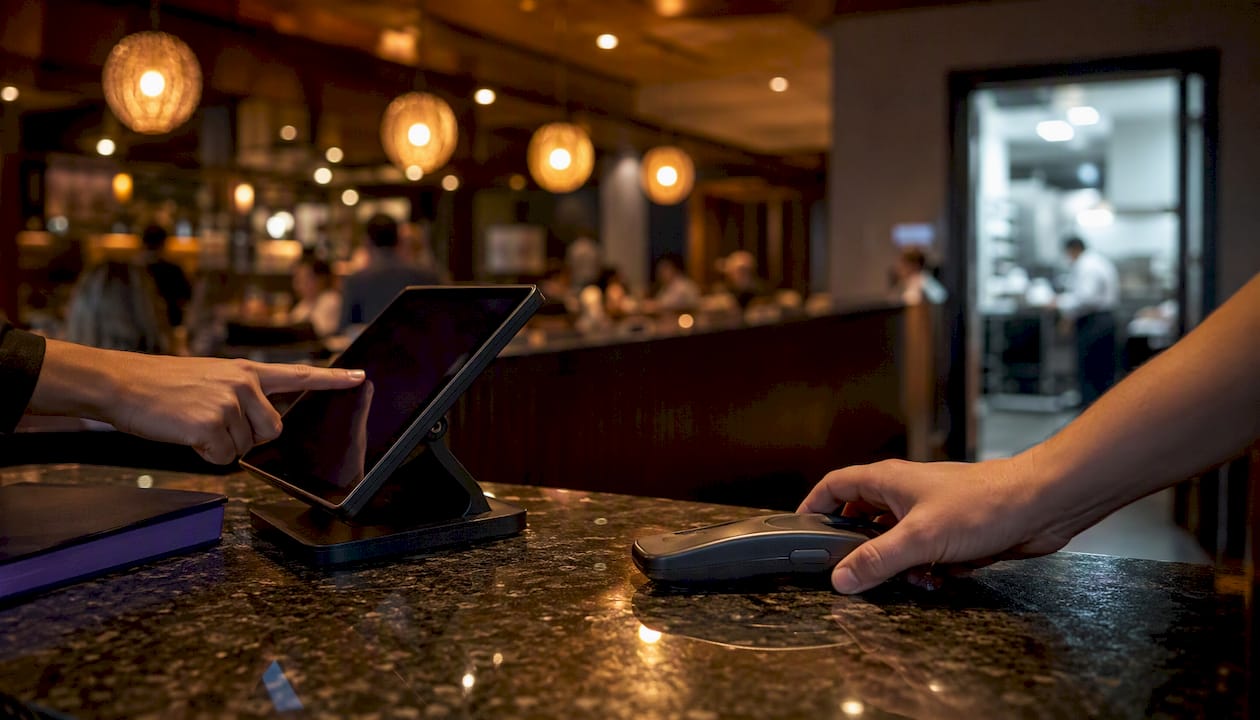
A restaurant's busiest call window is exactly when staff are least available to answer: Friday evening, Saturday lunch, holiday weekends. An AI receptionist handles reservation requests, confirms table availability, and sends SMS reminders to reduce no-shows, all while the kitchen is at full capacity. DEXCORE's restaurant-specific workflows include integrations with common booking platforms and automated confirmation flows that keep the host stand free for guests who are already in the room.
Clinics and medical offices
Patient calls to a medical office follow predictable patterns: booking, rescheduling, prescription refills, and directions. An AI agent handles the first three categories reliably, freeing clinical staff for patient care. Canadian clinics must handle personal health information under PIPEDA, so data residency and access controls are non-negotiable evaluation criteria. Clinic-specific AI receptionist deployments in Canada require a vendor that can speak clearly to where data is stored and who can access it.
Contractors and trades
A contractor missing a call during a job site visit loses the lead permanently in most cases. An AI receptionist answers, collects the job type, location, and preferred timing, and sends the lead directly to a dispatcher or CRM. DEXCORE's contractor workflows include dispatch handoffs and missed-call SMS recovery, so a caller who hangs up before the agent finishes still receives a follow-up text within minutes.

Service businesses: salons, consultancies, and multi-location operations
For a salon with three locations, the AI agent routes callers to the right location, checks stylist availability, and books the appointment without the caller being transferred between front desks. Consultancies use the agent to qualify inbound inquiries before they reach a senior team member, filtering out low-fit prospects and ensuring booked discovery calls are with decision-makers.
Pro Tip: Choose your first pilot use case based on where missed calls cost you the most, not where they happen most often. After-hours and marketing-campaign peaks are typically the highest-loss windows and the easiest to isolate for measurement.
Evidence, ROI signals, and what Canadian businesses can realistically expect
The ROI case for an AI receptionist rests on three variables: call volume, conversion rate from answered call to booked appointment or sale, and average transaction value.
When evaluating ROI, small businesses should model recovered leads and time saved, rather than focusing solely on the subscription cost. Staff hours redirected from call-answering to in-person service or sales activity represent a real productivity gain that does not show up in a simple cost comparison.
PIPEDA compliance note: Canadian businesses collecting caller personal information, including name, phone number, and appointment details, must handle that data in accordance with PIPEDA. When evaluating vendors, ask explicitly about data residency (is data stored in Canada?), retention policies, and access controls. A vendor that cannot answer those questions clearly is a compliance risk.
Dexcoretechnologies proof points:
- 24/7 answering with zero hold for concurrent callers
- Real-time appointment booking with calendar and CRM integration
- Industry templates for restaurants, clinics, contractors, and service businesses
- SMS confirmation and reminder workflows
- Canadian-focused deployment with PIPEDA-aware configuration
- Potential ROI of up to 942% based on recovered leads and operational savings
How to decide and run a 30-day pilot
Decision checklist — you are ready for an AI receptionist if:
- You receive more than 50 inbound calls per month
- More than 40% of calls are appointment-related or booking requests
- You miss calls regularly after hours, during lunch, or during peak periods
- Your CRM or calendar is already in use and has an API or integration layer
- Missed calls have a measurable cost (lost bookings, lost leads, customer complaints)
30-day pilot plan:
- Week 1: Configure the agent for one call type only (e.g., new appointment booking). Forward after-hours calls to the AI agent. Brief staff on the escalation process.
- Week 2: Monitor call logs daily. Identify the most common caller intents the agent is not handling and add those flows.
- Week 3: Expand to peak-hour coverage. Track calls answered, appointments booked, and escalations triggered.
- Week 4: Review KPIs against baseline. Calculate recovered revenue from previously missed calls. Decide on full deployment scope.
Questions to ask vendors during evaluation:
- Where is caller data stored, and does it stay in Canada?
- What CRM and calendar integrations are available natively vs. via Zapier?
- How does the warm transfer work, and what information does the receiving agent see?
- What is included in the onboarding fee, and what triggers additional charges?
- How are spam and robocalls handled?
- What is the escalation logic for frustrated or distressed callers?
Practical evaluation criteria include voice quality, customizable scripts, CRM and calendar integrations, and industry-specific features such as restaurant reservations or clinic intake flows. Prioritise vendors who can demonstrate those features in a live call, not just a slide deck.
Pro Tip: *Define your success metrics before the pilot starts, not after. Agree on three numbers: calls answered rate, appointments booked, and escalation rate.
The case for AI receptionists is strong, but the implementation details are where it gets decided
The evidence for AI receptionists is clear enough that the interesting question is no longer "should we do this?" It is "how do we do this without creating a worse experience for callers?"
The businesses that get the most from an AI receptionist are not the ones with the most sophisticated technology. They are the ones that invested two or three days in building scripts from real call data, defined a clear escalation path before go-live, and resisted the temptation to automate every call type at once. The ones that struggle are usually trying to replace a human receptionist entirely on day one, which puts the AI agent in situations it is not yet trained to handle.
The hybrid model, AI for routine calls and human fallback for complex ones, is not a compromise. It is the right architecture for most small and growing businesses, at least for the first six months. Once you have three months of call transcripts, you can see exactly which call types the agent handles well and which ones still need a human touch. That data makes the expansion decision obvious.
On compliance: Canadian businesses sometimes assume that because a vendor is "cloud-based," data residency is someone else's problem. It is not. PIPEDA places the obligation on the business collecting the data, not the vendor processing it. Ask the question directly, get the answer in writing, and check it against your own privacy policy before go-live.
Dexcoretechnologies: a Canadian-ready AI receptionist built for your industry
Missed calls are not a technology problem. They are a revenue problem, and the fix needs to work within your existing tools, your industry's compliance expectations, and your team's daily workflow.
Dexcoretechnologies is built specifically for Canadian businesses, with 24/7 AI answering, real-time appointment booking, and direct integrations with the calendars, CRMs, and POS systems you already use. Industry templates for restaurants, clinics, contractors, and service businesses mean you are not starting from a blank script. PIPEDA-aware configuration is part of the onboarding process, not an afterthought. The pilot is scoped, supported, and structured to show measurable results within 30 days. To see how it fits your call volume and workflow, Dexcoretechnologies.