
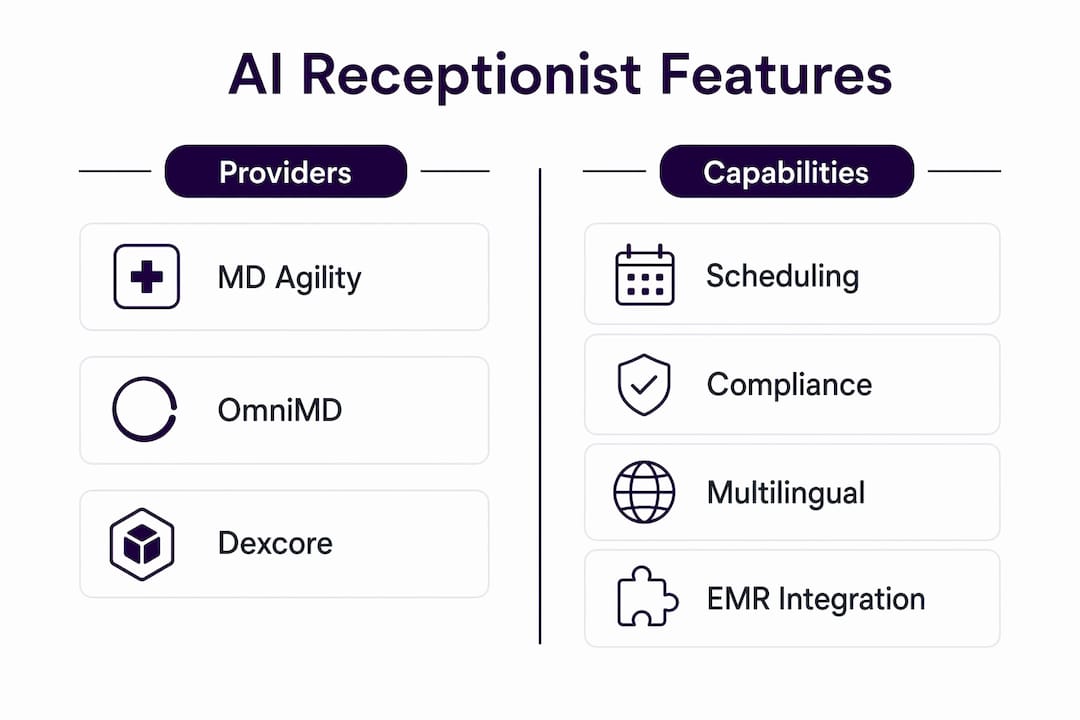
The best AI receptionist for a medical office is a HIPAA- and PHIPA-compliant, EMR-integrated platform built specifically for clinical workflows, not a generic answering bot repurposed for healthcare. For Ontario clinics in 2026, the strongest options combine 24/7 call coverage, real-time appointment booking, and proper clinical escalation routing. Here is what the top solutions offer:
MD Agility
- HIPAA-compliant inbound and outbound call handling with full EMR/EHR integration
- Appointment scheduling, insurance verification, prior authorisation, and prescription triage
- Complete front and back office support with trained medical receptionists
Keystone Medical Clinic (Ontario reference model)
- IRCC-approved panel physician with eMedical system processing
- On-site clinical assessment, blood tests, and chest X-ray
- Specialised immigration medical exams with transparent age-based pricing
Leading Medical Clinics of the World
- Professional family medicine and specialist services in Ontario
- Patient-centred reception integration across clinic locations
AI receptionists resolve up to 70% of scheduling calls without any human intervention, and platforms like OmniMD report dropping average hold times from over four minutes to under 30 seconds after activation.
How do the leading AI receptionists for Canadian medical clinics compare?
Ontario clinic managers need more than a feature list. The table below compares the three featured providers on the dimensions that actually drive purchasing decisions.
| Provider | Core Services | Compliance | EMR/EHR Integration | Appointment Booking | Multilingual | Pricing | Rating |
|---|---|---|---|---|---|---|---|
| MD Agility | Inbound/outbound calls, insurance verification, prior auth, prescription triage, patient intake | HIPAA compliant | Full EMR/EHR integration | Yes, integrated scheduling | Not publicly listed | Not publicly listed | 4.4★ (34 reviews) |
| Keystone Medical Clinic | Immigration medical exams, family medicine, eMedical submissions, on-site diagnostics | IRCC-approved panel physician | eMedical system | Yes, clinic-based booking | Not publicly listed | CA$120–CA$310 per exam by age | 4.9★ (259 reviews) |
| Leading Medical Clinics of the World | Family medicine, specialist referrals, patient-centred reception | Not publicly listed | Not publicly listed | Yes | Not publicly listed | Not publicly listed | 5★ (11 reviews) |
MD Agility is the most complete front-desk replacement in this group. It handles the full administrative cycle: a patient calls to book, the system verifies insurance eligibility in real time, routes prescription refill requests to the appropriate clinician, and logs everything directly into the clinic's EMR. For a busy multi-physician practice drowning in inbound volume, that end-to-end coverage is what separates it from a simple answering service.

Keystone Medical Clinic operates differently. It is not an AI receptionist vendor; it is an Ontario clinic that demonstrates what a well-integrated reception model looks like in practice. Its eMedical system handles IRCC submissions, and its pricing is publicly listed by age category: CA$120 for patients aged 0–10, CA$150 plus CA$50 for X-ray for ages 11–14, CA$220 plus CA$50 for ages 15–74, and CA$260 plus CA$50 for patients 75 and older. Refugee claimants under the Interim Federal Health program receive exams at no charge. Clinics offering immigration medical services should treat this as the benchmark for transparent, workflow-integrated reception.
Leading Medical Clinics of the World covers family medicine and specialist services across Ontario with a patient-centred reception model. Specific compliance certifications and EMR integration details are not publicly listed, so clinics with strict technical requirements should request that information directly before committing.

How to choose the best AI receptionist for your Canadian medical clinic
The decision comes down to five criteria, and skipping any one of them creates problems after go-live.
- Compliance certification. Your platform must meet HIPAA at minimum. Ontario clinics also fall under PHIPA and PIPEDA, so verify that the vendor explicitly covers all three, not just the US standard.
- EMR/EHR integration depth. A system that writes directly to your existing patient record eliminates the data-reconciliation step that causes billing errors. Ask whether it is a native integration or an API bridge, because the difference affects sync reliability.
- Clinical escalation logic. The AI must distinguish a routine booking call from an urgent clinical situation and route accordingly. Proper routing logic is a patient safety requirement, not a nice feature.
- Multilingual capacity. Ontario's patient population is linguistically diverse. A system that handles only English will create gaps in care access.
- Pricing transparency. Vendors who publish per-call or per-location rates upfront are easier to budget for. Hidden overage fees for after-hours or weekend coverage are common in traditional answering services; confirm the AI platform charges a flat rate.
For ambulatory or single-physician practices, start with a vendor that offers phased deployment, automating FAQs and appointment confirmations first before moving to insurance verification and intake. Larger multi-site clinics can move faster but need to confirm that the platform scales concurrent call handling without degrading response quality.
Pro Tip: Before signing any contract, run a two-week pilot on after-hours calls only. This tests escalation logic, EMR write accuracy, and patient experience with zero risk to your daytime workflow.
What makes a medical AI receptionist different from a generic virtual agent?
Generic virtual agents answer calls. Medical AI receptionists manage clinical workflows. The distinction matters the moment a patient calls about chest pain at 11 PM.
Healthcare-specific platforms include capabilities that generic tools simply do not carry:
- HIPAA/PHIPA-compliant data handling with end-to-end encryption, audit trails, and role-based access controls
- Real-time insurance verification at the point of scheduling, reducing claim rejections before the visit even happens
- Clinical escalation protocols that detect urgency in natural language and transfer immediately to on-call staff
- EHR-native scheduling that follows provider-specific rules for visit types, insurance plans, and location availability
- Multilingual conversational AI that adapts to diverse accents and handles interruptions without losing context
AI medical receptionists achieve an 83% patient satisfaction score in independent assessments, and OmniMD reports 99.7% accuracy in administrative task completion across scheduling, intake, and billing. Generic answering services cannot match either figure because they were not trained on clinical scheduling logic or healthcare privacy requirements.
Patient data security goes beyond encryption. A proper audit trail means every interaction is logged, timestamped, and reviewable, which matters when a regulatory body asks how a patient's information was handled six months ago.
Workflow automation and ROI from AI receptionists in Ontario clinics
The financial case for AI reception is direct. A full-time medical receptionist costs between $42,000 and $55,000 per year in base salary before benefits, overtime, or turnover. A two-receptionist front desk runs $120,000–$180,000 annually before a single patient is seen. AI platforms operate on a subscription model at a fraction of that cost, with no sick days or onboarding cycles.
Dexcoretechnologies reports that clinics and service businesses using its AI receptionist platform have achieved up to 942% return on investment through reduced missed calls, automated booking, and staff reallocation to higher-value tasks.
The mechanism is straightforward. AI handles the voicemail-callback loop that consumes the most front-desk time: a patient calls, leaves a message, staff calls back, the patient does not answer, and the cycle repeats. An AI receptionist resolves the booking on the first call, every time.
"Front desk teams handling 60 to 80 calls per day saw average hold times drop from over four minutes to under 30 seconds after AI activation. The difference is not just speed. The AI captures structured data on every call, which means fewer errors in the billing workflow and fewer denials from missing patient information." — Dr. Giri, Medical Director, OmniMD
Phased implementation is the most reliable path to that ROI. Clinics that automate high-frequency, low-complexity tasks first, such as appointment confirmations and FAQ responses, build staff confidence and system accuracy before moving to full clinical intake automation. Practices that skip phasing and automate everything at once tend to see higher error rates and staff resistance in the first 90 days.
Key takeaways
For Canadian medical clinics in 2026, the right AI receptionist is the one that meets your compliance obligations, integrates natively with your EMR, and handles clinical escalation correctly from day one.
| Point | Details |
|---|---|
| Compliance is non-negotiable | Your platform must explicitly cover HIPAA, PHIPA, and PIPEDA, not just one of the three. |
| EMR integration depth matters | Native integration eliminates sync errors; an API bridge introduces reconciliation risk. |
| Clinical escalation saves patients | Routing logic that distinguishes urgent calls from routine bookings is a patient safety requirement. |
| Phased rollout reduces errors | Start with FAQs and confirmations; add insurance verification and intake after the system proves accurate. |
| Dexcoretechnologies for Ontario clinics | Dexcoretechnologies offers 24/7 AI call coverage with workflow automation built for Canadian service businesses, including medical offices. |
The future of AI receptionists in Canadian healthcare
The clinics that adopt AI reception now are not just cutting costs. They are building the infrastructure that will handle the next wave of patient volume as Ontario's population ages and demand for primary care grows faster than the supply of administrative staff.
What I find underappreciated in most discussions of this technology is the compliance trajectory. PHIPA and PIPEDA are not static. Health Canada's pan-Canadian AI guiding principles signal that audit requirements and data governance expectations will tighten, not loosen. Clinics that choose vendors with weak audit trail capabilities today will face expensive migrations in two or three years when regulators formalise those requirements.
The other shift worth watching is AI's growing ability to handle genuinely complex clinical language. Current platforms excel at scheduling and FAQs. The next generation will manage nuanced triage conversations, understand medication names and dosage questions, and flag clinical risk patterns across call histories. Ontario clinics that have already integrated AI reception will be positioned to adopt those capabilities without rebuilding their workflows from scratch.
Dexcoretechnologies: 24/7 AI reception built for Canadian medical offices
If the comparison above showed you what a purpose-built medical AI receptionist can do, Dexcoretechnologies offers a practical path to that capability without the enterprise price tag or the six-month implementation timeline.
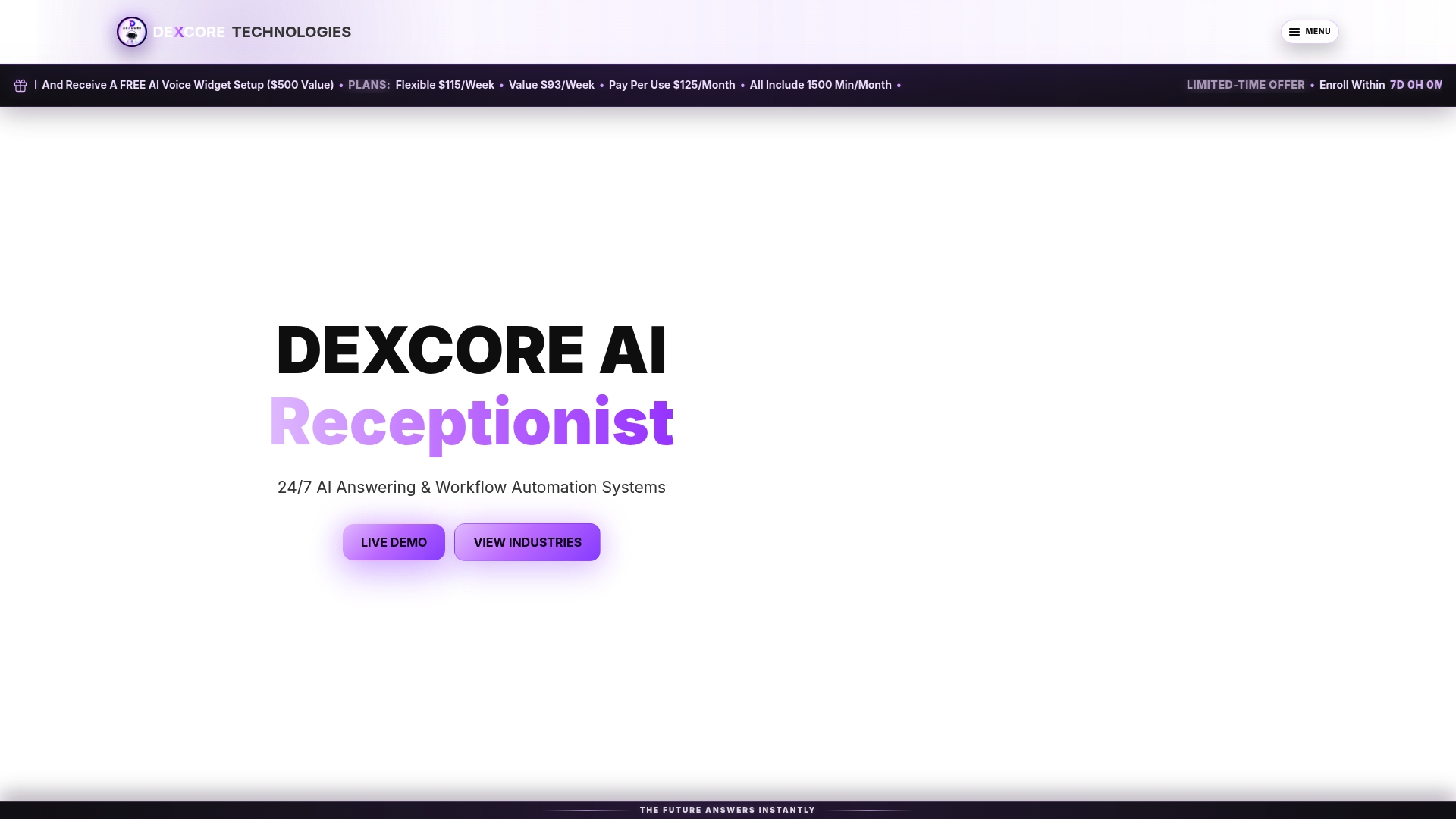
Dexcoretechnologies provides AI receptionist solutions with 24/7 call answering, real-time appointment booking, SMS confirmations, and workflow automation designed specifically for Canadian businesses, including medical clinics. Every missed call gets captured. Every booking request gets handled. Your front desk staff focus on patients in the room, not the phone queue. With a subscription model and professional onboarding included, you are operational in days, not months. Explore what Dexcoretechnologies can do for your clinic at dexcoretechnologies.ca.