
For most appointment-driven businesses, a managed or AI answering solution beats voicemail on the metric that matters: bookings kept. Voicemail is fine for internal or very low-volume lines, but revenue-facing calls need real-time intake. One industry estimate puts missed-call losses at $126,000 a year for a typical call-dependent small business. DEXCORE Technologies is one option built specifically for that gap.
TL;DR:
- Automated call intake handles unlimited simultaneous callers, reducing missed opportunities caused by busy signals or queueing delays.
- Transitioning to AI answering systems can recover missed call revenue that industry estimates put at up to $126,000 annually for small businesses.
- A two-week call audit helps determine if automated intake can significantly increase bookings and justify the upfront setup and monthly subscription costs.
- Voicemail remains suitable only for low-volume, non-revenue lines, or cases requiring privacy, while revenue-driving lines benefit from real-time engagement.
- A short pilot using real call data provides the clearest indication of potential ROI and guide decision-making before fully replacing voicemail systems.
Table of Contents
- Voicemail vs answering service: how call handling actually differs
- What do voicemail and answering services actually cost?
- When is voicemail still the right call?
- How do you replace voicemail with an AI answering workflow?
- What does DEXCORE bring to this comparison?
- What legal and privacy rules apply to answering services?
- How do voicemail systems compare technically to answering services?
- Which industries fit voicemail, and which need answering services?
- Why the "any answering beats none" assumption is wrong
- How do you evaluate DEXCORE before switching?
- Where to go for deeper numbers and how-tos
- Sources
- FAQ
Voicemail vs answering service: how call handling actually differs
Voicemail is a passive system. It records a message and waits for someone to listen, transcribe, and call back, often hours later. An answering service or AI receptionist works differently: it engages the caller immediately, asks the right questions, and moves them toward an outcome (a booked appointment, a routed message, an urgent escalation) before the call even ends.
That distinction shows up most clearly during peak demand. A single voicemail box can only take one message at a time, and if your team is already juggling three lines during a lunch rush or a morning clinic crunch, the fourth caller either waits or hangs up. AI answering systems don't have that ceiling. According to comparative analysis of AI answering services versus voicemail, automated intake can handle unlimited simultaneous callers, capturing intent and urgency on every single one, while human-staffed answering services still queue calls and can produce the same hang-ups voicemail does during a rush.
Consistency is the other gap. A voicemail message gets relayed by whoever checks it next, if they check it at all, and details get lost in translation. A trained automated workflow asks the same qualifying questions every time and logs the answer the same way every time.
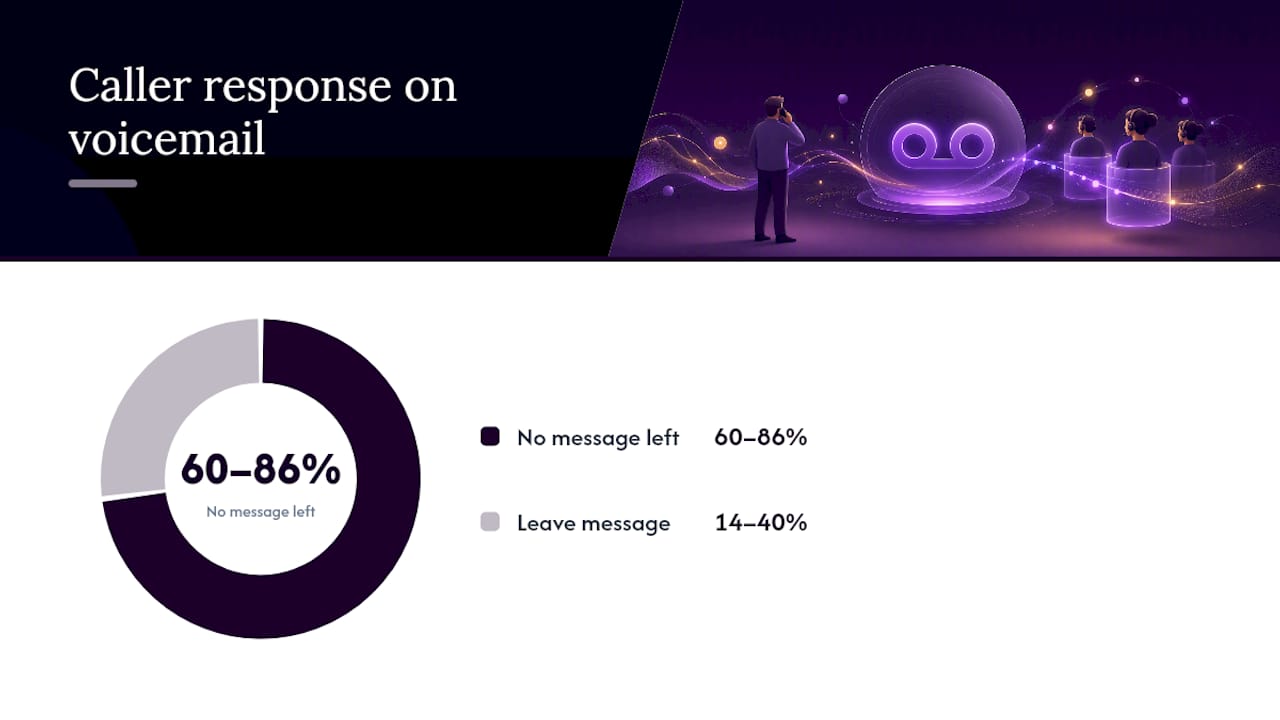
Caller behaviour backs this up. Industry data shows 60 to 86 percent of callers who reach voicemail won't leave a message, and a large share never call back. That's not a minor leak. It's most of your inbound volume disappearing before you even know it existed.
What actually differs between the two approaches, in practice:
- Voicemail records; it doesn't ask questions or take action.
- Answering services and AI receptionists capture intent, triage urgency, and can book directly into a calendar.
- Voicemail has no concurrency limit problem because it doesn't try to engage the caller at all, but that's precisely the weakness.
- AI systems scale to unlimited simultaneous calls; staffed answering services still queue.
- Message accuracy on voicemail depends entirely on the person relaying it; automated systems log structured data every time.
What do voicemail and answering services actually cost?
Pricing shapes matter as much as the sticker price. Voicemail is nearly free, but that's misleading. It's free right up until it costs you a booking. Human answering services typically bill per minute or per call, and those charges compound fast if your call volume climbs during busy season. AI receptionist platforms tend to run on flat monthly subscriptions instead, which scale more predictably as volume grows.
Here's a simple way to model whether switching pays off:
- Count your average monthly call volume and estimate what share currently goes to voicemail.
- Multiply the unanswered calls by your average booking value to estimate monthly leakage.
- Compare that leakage against the flat monthly cost of a managed or AI answering plan.
- If leakage exceeds the plan cost within the first month, the break-even is immediate, not theoretical.
Statistic Callout: Missed calls cost the average call-dependent small business an estimated $126,000 annually, according to recent industry analysis. Even a fraction of that recovered through consistent intake usually clears the cost of a subscription plan within weeks.
Watch for hidden per-minute overage fees and multi-year contracts buried in vendor quotes. Those two items turn an attractive base rate into a bad deal once your call volume shifts.
When is voicemail still the right call?
Voicemail isn't obsolete everywhere. It still makes sense in a handful of specific situations, and pretending otherwise does readers a disservice.
- Low-volume, non-revenue lines. An internal extension for supplier calls or HR questions rarely needs real-time intake.
- Administrative numbers. Billing inquiries or general information lines that don't drive bookings can tolerate a callback delay.
- Privacy-sensitive callers. Some customer bases, particularly in certain clinical or legal contexts, prefer knowing a human will personally review their message rather than an automated system.
- Temporary staffing gaps. A short-term coverage hole during a renovation or a staff transition doesn't always justify a full platform switch.
Pro Tip: Run a two-week call audit before deciding anything. Tag every incoming call as "revenue" or "admin." If more than a fifth of your revenue calls are hitting voicemail, that's your signal to move, not a guess.
A short checklist helps here: if your line takes bookings, quotes, or new patient calls, voicemail is probably costing you money right now. If it only takes internal or non-revenue calls, it can stay exactly as it is.
How do you replace voicemail with an AI answering workflow?
Switching from voicemail to answering service coverage doesn't need to be a quarter-long project. Most appointment-driven businesses can pilot a working setup inside a few weeks if they follow a defined sequence.
- Audit your calls. Classify two weeks of call logs into revenue calls (bookings, quotes, new clients) and administrative ones.
- Define scope. Decide whether you need overflow coverage only, after-hours coverage, or full 24/7 answering.
- Map your integrations. List the calendar, CRM, POS, or dispatch system that needs to receive booking data automatically.
- Build escalation rules. Set clear triggers for when a call needs a human immediately versus when automation can finish the job alone.
- Run a pilot and track metrics. Watch capture rate (calls answered versus missed), conversion rate (calls turned into bookings), and recovered revenue against your break-even estimate.
- Train your team and notify customers. A short internal briefing and a simple message update on your voicemail greeting go a long way.
Quick wins matter while the bigger rollout is underway. A voicemail-to-SMS setup deployed in under a week turns a dead-end message into an actionable text thread, which buys you time to build the full pilot properly. For contractors specifically, syncing answering automation directly into field service management software closes the loop between the call and the job schedule without manual re-entry.
- Keep the pilot window short (two to four weeks) so you get a clean read on results.
- Compare pilot data against your pre-switch missed-call baseline, not against a generic industry average.
What does DEXCORE bring to this comparison?
DEXCORE Technologies built its platform around the exact gap voicemail leaves open: calls that come in after hours, during rushes, or when nobody's free to pick up. The system answers 24/7, captures caller details, books directly into a calendar, and routes urgent requests to a person when needed, all without requiring someone to sit by the phone.
A demo-tested comparison of virtual receptionists against traditional answering services shows how these deployments perform against booking-based benchmarks in real conditions, not just marketing claims.
The platform advertises a potential ROI from automating intake and booking workflows. That figure comes from the publisher, not an independent audit, so treat it as a starting hypothesis worth testing against your own call volume during a pilot, not a guaranteed outcome.
Statistic Callout: Consumer research shows 38.9 percent of people still choose calling a business first when they need service, well ahead of website or FAQ searches at 13.8 percent. That's the channel voicemail is failing to protect.
- 24/7 AI call answering with real-time intake and booking
- Workflow automation covering CRM, calendar, and dispatch notifications
- Hybrid escalation paths that hand urgent or complex calls to a human
What legal and privacy rules apply to answering services?
Call recording and data handling rules vary by province and by the type of information collected, so there's no single blanket answer. Federally, Canada's Personal Information Protection and Electronic Documents Act (PIPEDA) governs how private-sector businesses collect and use personal information, including caller details gathered during an automated or staffed answering interaction. Some provinces, including Quebec, British Columbia, and Alberta, have their own private-sector privacy legislation that can apply instead of or alongside PIPEDA depending on the business.
Call recording consent rules matter just as much. Canadian law generally requires only one party to the call to consent to recording, but that's a floor, not a best practice. Clinics handling health information face additional obligations under provincial health privacy statutes, and any business collecting sensitive details, medical history, payment information, home addresses, should confirm its answering provider stores and transmits that data securely.
Before signing with any provider, ask directly: where is call data stored, how long is it retained, and who can access transcripts or recordings? A provider that can't answer clearly is a red flag regardless of price or features. This isn't a section to skim past; a missed compliance detail costs far more than a missed call ever will.
How do voicemail systems compare technically to answering services?
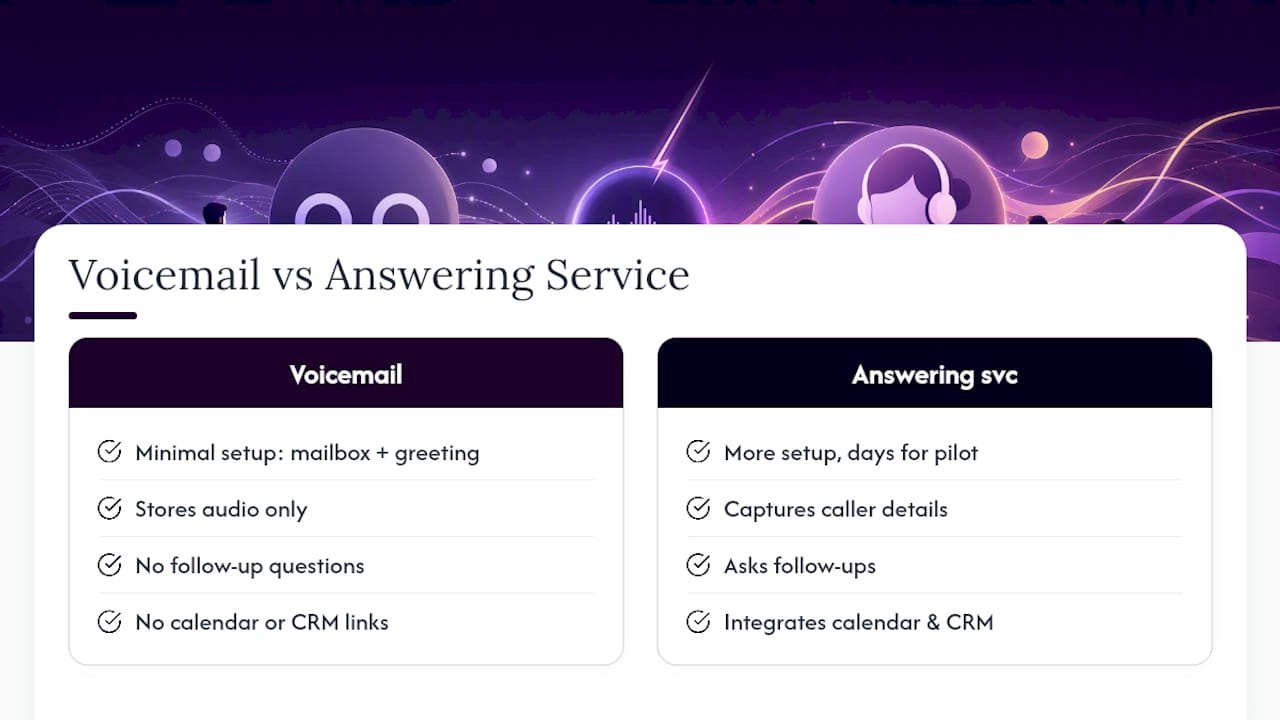
Voicemail runs on infrastructure most businesses already have baked into their phone system or carrier plan. It needs almost no setup: a mailbox, a greeting, and a way to check messages. That simplicity is also its ceiling. Voicemail can't ask a follow-up question, can't check calendar availability, and can't distinguish an urgent call from a routine one. It just stores audio.
Answering services and AI receptionists need more upfront integration work but deliver far more capability in return. A working setup typically connects to your booking calendar, CRM, and sometimes point-of-sale or dispatch software, so a captured call turns into a scheduled appointment or a logged lead without anyone re-typing information. That means slightly more setup time than flipping on a voicemail greeting, usually measured in days rather than months for a focused pilot.
The trade-off is dependency. Voicemail works even during an internet outage as long as phone lines are up. Cloud-based AI answering platforms need reliable connectivity and a properly configured fallback plan for outages or system downtime. Any business evaluating a switch should ask a prospective provider what happens during an outage, not assume it's covered.
For businesses already comparing multi-channel options, tools like AI conversational assistants show how similar automation logic extends beyond phone calls into chat and messaging, which is worth considering if your customers split their contact preferences across channels.
Which industries fit voicemail, and which need answering services?
The right choice tracks closely with how directly a missed call threatens revenue. Restaurants taking reservations, clinics booking patient appointments, contractors fielding estimate requests, and transport or delivery companies coordinating pickups all share one trait: a missed call is very often a missed customer, not just a missed conversation.
Restaurants lose same-night reservations when a caller hits voicemail during a Friday rush and simply calls the next place on their list. Clinics face a similar problem with new patient calls, where a delayed callback frequently means the patient has already booked elsewhere. Contractors lose quote requests to whichever competitor answers first, and transport or delivery firms lose time-sensitive bookings that can't wait for a callback.
Voicemail still fits industries and use cases where the call itself isn't tied to a transaction. Internal corporate extensions, HR lines, supplier and vendor communication, and general inquiry numbers for organizations that don't book appointments over the phone can run on voicemail without measurable cost. The difference isn't about industry size or budget; it's about whether the phone line is a revenue channel or an administrative one. Appointment-driven businesses of any size should treat their booking line as revenue infrastructure, not a communication afterthought.
Why the "any answering beats none" assumption is wrong
The conventional advice treats voicemail and answering services as a binary: either you answer calls somehow, or you don't. That framing misses the real issue. The problem with voicemail isn't that it fails to answer calls; it's that it answers them in a way callers have learned to ignore. Most people don't leave a message anymore because years of unreturned voicemails taught them not to bother.
What gets underrated in most advice on this topic is how much of the fix is structural, not technological. A business doesn't need the fanciest AI system available. It needs a system that acts the moment the phone rings, every time, regardless of volume or time of day. That's a workflow problem before it's a software problem.
If you're an operations manager reading this trying to decide where to start, don't start with vendor comparisons. Start with the two-week call audit mentioned earlier. You can't fix leakage you haven't measured, and most businesses are surprised by how much of their "missed call problem" is concentrated in just a few predictable hours each week.
— James
How do you evaluate DEXCORE before switching?
If you're weighing whether to move off voicemail, a short pilot beats a long sales conversation every time. DEXCORE's onboarding typically starts with a demo built around your actual call patterns, followed by a scoped audit of your busiest hours and a short trial period where the system runs alongside your existing setup rather than replacing it outright.
During that pilot, track three numbers: how many calls get answered versus missed, how many of those turn into confirmed bookings, and how that compares to your pre-switch baseline. Those three figures tell you more than any spec sheet. If you run a restaurant juggling reservation surges, the restaurant-focused AI receptionist is built around exactly that call pattern. Clinics, contractors, and other appointment-based operations fit better with the service business receptionist setup, which handles booking, routing, and CRM sync in one workflow. Either way, start with a demo and let two weeks of real call data make the decision for you.
Where to go for deeper numbers and how-tos
For channel preference and automation trust data, the Consumer Patience Index is the strongest source available. DEXCORE's own blog covers deployment specifics, including its demo-tested booking comparison and alternatives roundup for small business AI answering. For deeper missed-call cost benchmarks, see the missed calls cost analysis referenced earlier.
Sources
- Consumer Patience Index 2026
- AI Receptionist vs Answering Service in 2026: The Complete Cost, Performance, and Buyer's Guide for Service Businesses - NewWay Insider
FAQ
Is voicemail enough for a small appointment-based business?
Usually not, if the line takes bookings or new client calls. Voicemail works fine for internal or administrative numbers with low call volume.
What's the real difference between an answering service and voicemail?
Voicemail passively records a message; an answering service or AI receptionist actively engages the caller, captures intent, and can book an appointment in real time.
How much do missed calls actually cost a business?
Industry estimates put missed-call losses at roughly $126,000 a year for a typical call-dependent small business, though the exact figure depends on call volume and average booking value.
Does switching from voicemail require a long contract?
Not necessarily. Many AI receptionist platforms run on flat monthly plans with short pilot periods rather than the multi-year contracts common with some traditional answering services.
Can AI answering services handle after-hours calls only?
Yes. Most deployments let you scope coverage to overflow, after-hours, or full 24/7 answering, so you can start narrow and expand once the pilot shows results.