
Replacing IVR with AI voice agents is practical, advisable, and increasingly the default choice for Canadian contact centres that want to stop haemorrhaging calls to abandonment. The immediate next step is an audit: pull 30–90 days of call logs, identify your single highest-volume, lowest-complexity intent, and run that one flow as a pilot with a DTMF fallback in place. From there, the path to full replacement follows a 90-day programme that any CX team can budget and schedule. Canadian organisations must also account for PIPEDA obligations from day one, including call recording consent and data residency. Dexcoretechnologies is built specifically for this market and can serve as your implementation partner from audit through scale.
Key facts to anchor your business case:
- Gartner research finds only 14% of customer-service issues are fully resolved through self-service, which means your IVR is already failing most callers before AI enters the picture.
- Industry migration guides report significant average handle time (AHT) reductions for calls resolved by AI voice agents.
- An iterative migration that starts with one intent and maintains a dual-stack DTMF fallback is the most reliable strategy for de-risking the transition and generating per-intent ROI data.
Key takeaways
Replacing IVR with AI voice agents delivers measurable containment, AHT, and CSAT gains when the migration follows an iterative, governance-first 90-day plan anchored to a single high-volume pilot flow.
| Point | Details |
|---|---|
| Audit before you build | Pull 30–90 days of call logs, score intents by volume and complexity, and pick one pilot flow before writing a single line of conversation design. |
| Run shadow mode first | Deploy in shadow mode for two to three weeks before routing live traffic; compare AI dispositions against actual IVR outcomes to catch failures before callers do. |
| Comply with PIPEDA from day one | Record consent language, data-flow documentation, and provincial health-data rules must be in place before any live call is processed. |
| Measure per intent, not in aggregate | Per-intent A/B cohorts reveal where AI is winning and where it is not; aggregate metrics mask underperforming flows and delay corrective action. |
| Dexcoretechnologies for Canadian deployments | Dexcoretechnologies delivers 24/7 AI receptionist services with vertical templates, CRM integrations, and PIPEDA-aligned governance for Canadian businesses. |
Table of Contents
- Why does legacy IVR keep failing your customers?
- What can AI voice agents do that IVR simply cannot?
- What does a practical 90-day migration programme look like?
- How do you audit your IVR and choose the first flows to automate?
- What technical requirements must you meet before going live?
- What privacy and governance rules apply to Canadian organisations?
- Which KPIs should you track, and how do you build a simple ROI case?
- How do you test before launch and monitor after?
- What do sample call flows look like for restaurants, clinics, and contractors?
- What must be on your pre-launch checklist?
- How does a Dexcoretechnologies implementation look in practice?
- When should you replace IVR entirely, and when should you augment it?
- Dexcoretechnologies: Canada-ready AI voice agents, ready to deploy
- Sources
Why does legacy IVR keep failing your customers?
The core problem with DTMF-driven IVR is that it forces callers to do the routing work. A caller who wants to reschedule an appointment must navigate a menu tree designed around your org chart, not their intent. By the time they reach the right leaf node, they have already pressed four digits, listened to three prompts, and spent 90 seconds doing nothing productive. Many give up before they get there.
The failure modes compound quickly:
- Menu depth: Each additional menu level roughly doubles the probability of a misroute or an abandonment. Three-level menus are common; five-level menus are not rare.
- Misroutes: A caller who says "billing" but means "cancel my service" lands in the wrong queue, triggering a transfer and resetting the clock on their wait time.
- DTMF limits: Touch-tone systems cannot capture free-form intent. A caller who says "I need to change my delivery address for tomorrow's order" has no digit to press.
- No resolution, only routing: Legacy IVR almost never resolves anything. It routes. The actual work still falls to a human agent, which means every call that reaches the IVR is a cost centre, not a service moment.
The metric damage is predictable. Abandonment rates climb when menu depth exceeds three levels. Containment rates, the share of calls the IVR handles end-to-end without a human, typically sit near zero for DTMF systems because resolution was never the design goal. Gartner's research showing only 14% of customer-service issues are fully resolved in self-service is a ceiling, not a floor. Most IVR deployments fall well below it.
CSAT takes the most visible hit. Callers remember the friction. They remember pressing 3, then 2, then 1, then being told the office is closed. That experience shapes how they feel about your brand, not just your phone system.
What can AI voice agents do that IVR simply cannot?
The shift from DTMF menus to conversational AI voice agents is not an incremental upgrade. It is a different category of tool.
Natural-language intent capture means a caller can say "I want to move my Thursday appointment to Friday afternoon" and the agent understands the intent, queries the booking system, checks availability, and confirms the change, all without a human. No menu. No transfer. No hold music. That is a resolved call, not a routed one.
The operational outcomes are concrete. After-call work drops sharply too: AI agents produce call summaries, draft follow-up messages, and create CRM tickets automatically, which cuts the administrative tail that inflates agent cost-per-call. Automating phone support in this way often produces faster ROI than per-call containment gains alone, because the time savings on after-call work compound across every handled call.
24/7 availability is a structural advantage. A caller who phones your clinic at 10 PM on a Sunday to book a Monday appointment either gets an answer or they call a competitor. AI voice agents answer every call, every time, without overtime costs.
Fewer misroutes and fewer missed leads follow naturally from intent-based routing. When the agent understands what a caller wants before deciding where to send them, routing accuracy improves. For businesses that live on inbound leads, a missed call is a lost sale. An AI agent that captures the caller's name, need, and preferred callback time, then fires a CRM record and an SMS confirmation, converts that call even when no human is available.
Accessibility also improves. A well-designed AI voice agent handles varied accents, speech patterns, and pacing more gracefully than a DTMF system that times out after four seconds of silence. For Canadian organisations serving bilingual or multilingual communities, that matters.
The one honest constraint: Gartner's finding that only 14% of issues are fully resolved in self-service is a reminder that AI voice agents are not a replacement for human agents. They are a filter. The goal is to resolve what can be resolved automatically and hand off everything else with full context, so the human agent starts from a position of knowledge rather than a blank slate.
What does a practical 90-day migration programme look like?
A progressive, iterative migration that starts with one high-volume, low-complexity intent is the most reliable path. The 90-day structure below gives you a budget-ready timeline with clear gates.
Weeks 1–3: audit and design
- Pull 30–90 days of call logs and tag every call by intent, resolution type, and handle time.
- Score intents using the matrix in the next section and select your pilot flow.
- Map the data integrations required (CRM, booking system, POS) and confirm API access.
- Draft the conversation design, escalation rules, and DTMF fallback logic.
- Obtain legal sign-off on recording consent language and data handling.
Weeks 4–6: build and simulate
- Build the pilot flow in your chosen platform, including tool calls to live data sources.
- Run synthetic call simulations across personas, noise conditions, and edge cases.
- Set pass/fail thresholds per legacy leaf node and iterate until the pilot meets them.
- Configure monitoring dashboards and low-confidence alert thresholds.
Weeks 7–9: shadow mode and A/B testing
- Deploy in shadow mode: the AI processes calls alongside the IVR but does not take live traffic.
- Compare AI decisions against actual IVR outcomes and human dispositions.
- Open a 10% live traffic cohort once shadow results meet acceptance criteria.
- Measure per-intent containment, AHT, and CSAT against your baseline.
Weeks 10–12: scale and decommission
- Ramp traffic progressively: 10% → 25% → 50% → 75% → 100%, with a 48-hour hold at each gate.
- Confirm rollforward criteria are met at each gate before advancing (see table below).
- Decommission the legacy IVR leaf nodes that the AI has fully absorbed.
- Document the model version, prompt library, and integration state for governance records.
Callers who learned your old menu will still try to use it, and a graceful fallback preserves trust while the new experience becomes familiar.*
How do you audit your IVR and choose the first flows to automate?
The audit is where the migration either succeeds or stalls. Teams that skip it tend to pick the wrong pilot flow, hit unexpected integration complexity, and lose executive confidence before the AI has a fair chance.
Start by exporting call logs for the past 30–90 days. Tag each call with: intent (what the caller wanted), resolution type (self-served, transferred, abandoned, escalated), handle time, and the IVR leaf node reached. If your telephony platform does not tag intents automatically, a random sample of 200–300 call recordings with manual tagging is sufficient to build a reliable distribution.
Once you have the distribution, score each intent against four dimensions:
| Intent | Volume (calls/month) | Complexity (1–5) | Risk (1–5) | Integration effort (1–5) | Pilot score |
|---|---|---|---|---|---|
| Appointment confirmation | High | 1 | 1 | 2 | Excellent |
| Order status | High | 2 | 1 | 2 | Excellent |
| Hours and location | High | 1 | 1 | 1 | Excellent |
| Simple payment | Medium | 3 | 3 | 3 | Good |
| Complaint intake | Medium | 4 | 4 | 2 | Poor |
| Complex billing dispute | Low | 5 | 5 | 4 | Exclude |
The pilot score is a function of high volume, low complexity, low risk, and manageable integration effort. Appointment confirmation, order status, and hours/location queries consistently top this matrix across industries. They are high-frequency, the data they need is available via a single API call, and a mishandled interaction carries low reputational risk.
Misroute analysis is equally important.
What technical requirements must you meet before going live?
Production-grade AI voice agents require more than a conversation design. The engineering foundation has to be solid before a single live call routes through the new system.
Telephony layer
- PSTN/SIP trunking: Confirm your carrier supports SIP trunking with the latency profile the AI platform requires. End-to-end latency above 800 ms degrades the conversational experience noticeably.
- Number porting: Plan for a porting window of two to four weeks with your Canadian carrier. Do not schedule a go-live date without a confirmed port date.
- DTMF dual-stack: Keep DTMF handling active in parallel. Callers on older handsets or with accessibility needs may rely on it, and it is your fallback during any AI platform degradation.
Backend integrations
- CRM and booking systems: The AI agent needs read/write access to your CRM to capture leads, confirm appointments, and update records. REST APIs with OAuth 2.0 are the standard; avoid screen-scraping workarounds.
- OMS and POS: For order status and payment flows, the agent must query live operational data. Emerging standards-based integrations now let AI assistants query live customer-service data securely, which is a meaningful improvement over static exports that go stale within hours.
- Calendar and ticketing: Appointment booking requires bi-directional calendar access. Ticket creation for escalated calls should happen automatically, with the transcript and detected intent attached.
Operational requirements
- Conversation state management: The agent must maintain context across a multi-turn call. A caller who says "actually, make it 3 PM instead" mid-booking should not have to restart.
- Transcript delivery: When a call escalates to a human agent, the full transcript, detected intent, and any structured data collected (name, account number, preferred time) must appear on the agent's desktop before they pick up. Salesforce research shows that organisations with integrated service-channel data report higher AI success rates and more time freed for reps.
- Observability and logging: Every call should produce a structured log entry with intent, confidence score, resolution type, handle time, and any tool calls made. This is your monitoring substrate and your audit trail.
What privacy and governance rules apply to Canadian organisations?
Canadian organisations face a specific compliance environment that differs from US or EU deployments. Getting governance right before launch is not optional; it is a condition of operating legally.
PIPEDA and provincial rules
- PIPEDA requires meaningful consent for the collection, use, and disclosure of personal information. A call recording that captures a caller's name, health concern, or financial detail is personal information under PIPEDA. Consent must be obtained at the start of the call, before any data is collected.
- Provincial health-data rules: Ontario's PHIPA, Alberta's HIA, and British Columbia's PIPA impose additional obligations on health information custodians. If your AI voice agent handles appointment booking for a clinic, you are likely a health information custodian or agent under the applicable provincial statute. Confirm with legal counsel before launch.
- Data residency: PIPEDA does not prohibit cross-border data transfers, but it requires that equivalent protection be in place. If your AI platform processes or stores call recordings outside Canada, document the transfer mechanism and the contractual safeguards in place.
- Processor documentation: Maintain a data-flow map that names every sub-processor (telephony carrier, ASR provider, LLM provider, CRM) and the data each one touches. This is your evidence of accountability under PIPEDA.
Recording and consent practices
- Play a clear notice at the start of every call: "This call may be recorded for quality and service purposes." This satisfies the notice requirement under PIPEDA and most provincial statutes.
- Offer an opt-out path. A caller who declines recording should still be able to reach a human agent.
- Store recordings in encrypted storage with access controls and a defined retention period. Ninety days is a common default; confirm with your legal team based on your sector.
Operational governance
- Maintain a versioned prompt library. Every change to a prompt is a change to the agent's behaviour and must be logged with a date, author, and rationale.
- Set explicit low-confidence escalation thresholds. When the AI's confidence score falls below your defined floor, the call transfers to a human automatically, with the transcript attached. Stanford HAI research on hallucination risks in LLM-driven systems makes clear that detection and escalation mechanisms are not optional features.
- Keep an audit trail for model updates. If a regulatory inquiry arises, you need to be able to show what version of the model was running on a given date and what it was instructed to do.
Pro Tip: Assign a named "conversation owner" in operations, not in engineering, for each live flow. This person approves prompt changes, reviews low-confidence escalation logs weekly, and owns the CSAT score for that intent. Operator ownership of flows is one of the strongest predictors of migration success.
Which KPIs should you track, and how do you build a simple ROI case?
Six metrics cover the full picture for an IVR-to-AI migration. Baseline all six for four to eight weeks before the pilot goes live, then compare per-intent A/B cohorts rather than aggregate numbers. Aggregate metrics hide where the AI is winning and where it is not.
- Containment/automation rate: The share of calls the AI resolves end-to-end without a human. This is your headline metric.
- Average handle time (AHT): Measure separately for AI-resolved calls and human-handled calls. AI-resolved AHT should fall as the model improves.
- First-call resolution (FCR): The share of calls where the caller's issue is resolved on the first contact. AI agents that resolve and confirm in one call improve FCR directly.
- CSAT: Collect post-call surveys for both AI-handled and human-handled calls. A CSAT gap between the two cohorts tells you where the AI needs work.
- Abandonment rate: Track per intent and per time-of-day. A spike in abandonment after AI deployment is an early warning sign of a broken flow.
- Cost per handled call: Total contact-centre cost divided by total calls handled. This is your ROI denominator.
A simple ROI formula
Monthly savings = (Calls deflected to AI × Agent cost per call) + (After-call work minutes saved × Agent hourly rate / 60) minus AI platform monthly cost
At $12 each, that is $24,000 in avoided agent cost per month. Add after-call automation savings (summaries, ticket creation, follow-ups) and the ROI compounds further. Sensitivity drivers are call volume, agent fully-loaded cost, and the AI platform's per-call or subscription cost.
How do you test before launch and monitor after?
Pre-launch testing
Shadow mode and synthetic simulation are the two non-negotiable pre-launch steps. Run synthetic call simulations across a range of personas, accents, noise conditions, and edge cases. Academic work on dialogue policy evaluation supports using formal evaluation rubrics and simulation to validate agent behaviour before routing live traffic. Set numeric pass/fail thresholds per legacy leaf node and do not advance to live traffic until every node meets its threshold.
Shadow mode runs the AI in parallel with the live IVR: the AI processes every call and logs what it would have done, but the caller still hears the IVR. Compare AI dispositions against actual outcomes for two to three weeks. Any intent where the AI's shadow containment rate is lower than the IVR's actual containment rate needs more work before going live.
Pro Tip: Build a "red team" call set of 50–100 adversarial calls: callers who give ambiguous intents, switch topics mid-call, or try to extract information the agent should not provide. Run this set after every significant prompt change, not just at launch.
Post-launch monitoring
- Per-intent containment tracked daily for the first 30 days, then weekly.
- Low-confidence alert rate: the share of calls where the agent's confidence score fell below the escalation threshold. A rising rate signals model drift or a new intent pattern emerging.
- Handoff failure rate: calls where the escalation to a human failed (dropped call, wrong queue, no transcript delivered). This is your reliability metric.
- Audio quality metrics: latency, packet loss, and speech recognition error rate. Degraded audio is the most common cause of unexplained CSAT drops.
Continuous improvement runs on a monthly retraining cadence for the first quarter, then quarterly once the model stabilises. Every batch of low-confidence escalations is a training signal. Review them with the conversation owner, update the prompt library, and log the change.
What do sample call flows look like for restaurants, clinics, and contractors?
Three flows cover the majority of pilot candidates across Dexcoretechnologies's core verticals. Each is designed to be built, tested, and launched within the 90-day programme.
| Flow | AI resolves | Escalate to human when | Key data fields required |
|---|---|---|---|
| Restaurant reservation | Booking, confirmation, cancellation, waitlist add | Party size >10, special event, allergy complexity | Name, party size, date, time, phone, email, dietary notes |
| Clinic appointment booking | Book, reschedule, cancel, send reminder | Clinical triage question, urgent symptom, insurance dispute | Patient name, DOB, appointment type, preferred date/time, phone, health card number |
| Contractor dispatch | Job intake, scheduling, address capture, technician notification | Complex scope, hazmat, emergency after-hours | Name, address, job type, preferred window, contact number, urgency flag |
For the restaurant flow, the AI agent queries the booking system in real time, confirms availability, books the table, and fires an SMS confirmation to the caller. No human involved. For the contractor dispatch flow, the agent captures the job details, checks the technician schedule, assigns the nearest available tech, and sends a notification to both the technician and the customer.

The escalation rules are as important as the resolution logic. A clinic agent that attempts to triage a caller describing chest pain is a liability. The escalation trigger must be explicit: any symptom description routes immediately to a human, with the transcript attached and a flag on the record.
What must be on your pre-launch checklist?
A missed item on this list is a production incident waiting to happen. Walk every item to "confirmed" before flipping traffic.
- Stakeholder sign-off: CX lead, legal, IT, and operations have all reviewed and approved the pilot scope, escalation rules, and recording consent language.
- DTMF fallback live: The legacy IVR is still active and reachable. A "press 0 for a human" option is available at every point in the AI flow.
- Monitoring dashboards active: Per-intent containment, low-confidence alert rate, handoff failure rate, and audio quality metrics are all visible and alerting.
- Agent training complete: Human agents know the AI is live, understand what calls will escalate to them, and know how to read the transcript and intent data on their desktop.
- Legal sign-off on recordings: Recording consent language has been reviewed and approved for the target province(s).
- Rollback plan documented: The steps to revert all traffic to the legacy IVR are written down, tested, and known to the on-call engineer. Target rollback time: under 15 minutes.
- Customer communication sent: If the change is visible to callers (new greeting, new voice), a brief notice on your website and hold messaging prepares them.
- Internal communication sent: Front-line staff, supervisors, and the contact-centre manager all know the go-live date, what to expect, and who to call if something looks wrong.
For rollback: if containment drops more than 10 percentage points from the shadow baseline, or if CSAT falls more than 0.5 points within the first 48 hours of live traffic, revert to the legacy IVR immediately and investigate before re-launching.
How does a Dexcoretechnologies implementation look in practice?
The following describes a representative implementation pattern based on Dexcoretechnologies's approach for Canadian businesses. Specific metrics are presented as ranges reflecting typical outcomes rather than guaranteed results.
Dexcoretechnologies runs implementations in five phases: audit, build, test, rollout, and iterate. The audit phase typically takes one to two weeks and produces a prioritised flow list, an integration map, and a compliance checklist. Build and test run concurrently over two to four weeks, with synthetic simulation and shadow mode completing before any live traffic is routed. Rollout follows the progressive ramp described in the 90-day plan above.
Typical outcome ranges reported by Dexcoretechnologies clients:
- Containment uplift of 30–60 percentage points versus legacy IVR for the pilot flow.
- AHT reductions of 25–45% for AI-resolved calls.
- Time to first pilot go-live: four to six weeks from audit completion.
What Dexcoretechnologies delivers as part of its service: professional onboarding and conversation design, CRM and calendar integrations, monitoring dashboards, PIPEDA-aligned recording consent setup, and ongoing support with a monthly optimisation review. The platform covers restaurants, clinics, contractors, service businesses, and transport and delivery operations, with vertical-specific workflow templates for each.
For organisations evaluating AI voice agent alternatives, Dexcoretechnologies's Canada-first compliance posture and included onboarding support distinguish it from platforms that require you to build and govern everything yourself.
When should you replace IVR entirely, and when should you augment it?
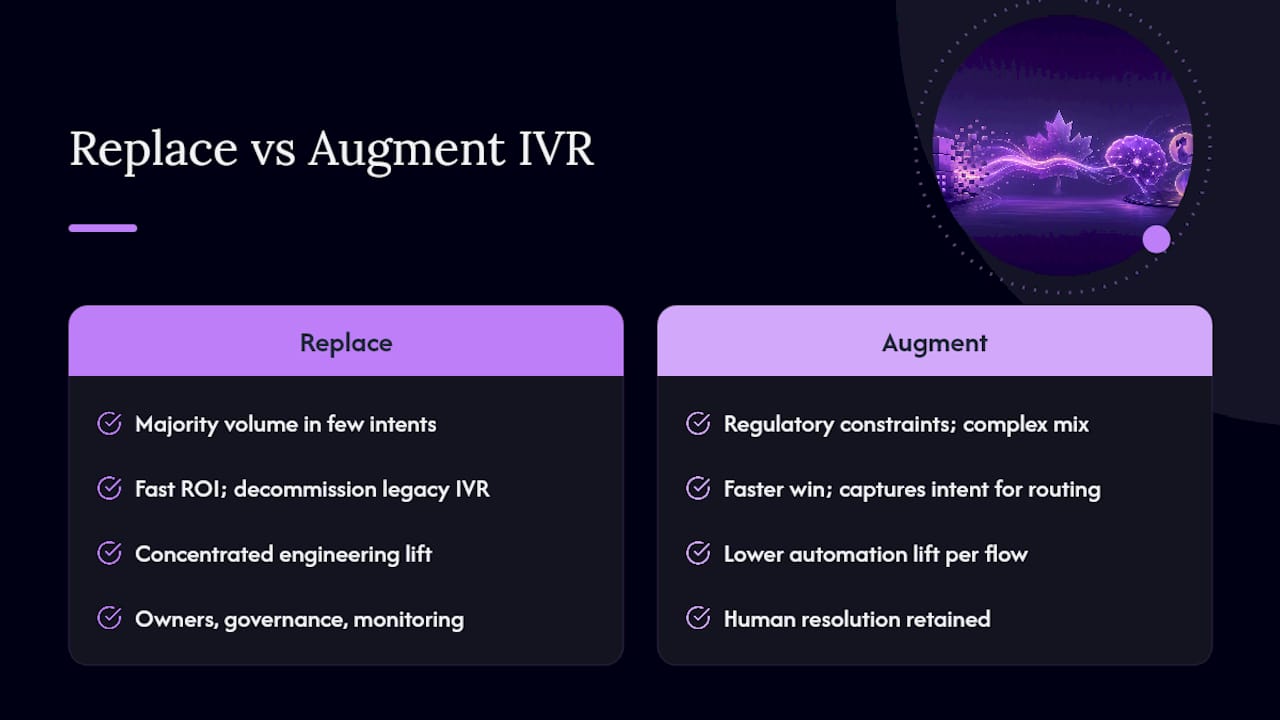
The honest answer is that most organisations should replace, not augment. Augmentation, layering a natural-language front end onto an existing DTMF tree, preserves the underlying routing logic that caused the problem in the first place. You get a better first impression but the same misroute rates and the same containment ceiling.
Full replacement makes sense when the majority of your call volume falls into a handful of high-frequency, low-complexity intents. The engineering lift is concentrated, the ROI is fast, and the legacy IVR can be decommissioned cleanly once the AI has absorbed those intents.
Augmentation is the right call in two specific situations. First, when regulatory constraints make full automation of certain flows genuinely risky, for example, a financial services firm where compliance rules require a human on certain transaction types. Second, when the call mix is genuinely complex and heterogeneous, with many low-volume, high-complexity intents that would each require significant conversation design work. In that case, augmenting the front end to capture intent and route more accurately, while leaving resolution to humans, is a faster win than trying to automate everything at once.
The organisational readiness question matters as much as the technical one. A full replacement requires a named conversation owner for each flow, a governance process for prompt changes, and a monitoring culture that treats per-intent containment as a live operational metric. Teams that lack those capabilities tend to build the AI and then ignore it, which produces a system that degrades quietly over months. If your organisation is not ready to own the flows operationally, start with augmentation and build the muscle before attempting full replacement.
The telecom latency risk is real but manageable. Canadian carriers vary in SIP trunking quality, and a poorly configured trunk can add 200–400 ms of latency that makes the AI feel unresponsive. Test your trunk before committing to a go-live date.
Dexcoretechnologies: Canada-ready AI voice agents, ready to deploy
No missed call should cost you a booking, a lead, or a patient. Dexcoretechnologies gives Canadian businesses a 24/7 AI receptionist that answers every call, books appointments in real time, captures lead details, and fires CRM updates and SMS confirmations without a human in the loop. The difference from a generic voice assistant is the workflow layer: every call triggers the right downstream action, whether that is a calendar entry, a dispatch notification, or a follow-up reminder.
For restaurants, clinics, contractors, and service businesses, Dexcoretechnologies includes vertical-specific templates, PIPEDA-aligned consent setup, and full CRM and booking-system integrations. Onboarding is included in every plan, and the first pilot flow is typically live within four to six weeks of the audit. The platform is built for Canada, governed for Canada, and supported by a team that knows the Canadian telecom environment.
Book a migration audit or request a demo to see how your highest-volume call flow performs as an AI pilot. For service businesses specifically, the AI receptionist for service businesses page shows exactly what the platform handles.
Sources
The following sources informed the migration timeline, governance notes, and ROI framework in this guide:
- Delight.ai launches Delight Agent MCP for AI assistant access to live customer service data | PR Newswire
- ArXiv preprint (neural conversation / policy literature)
- Gartner survey finds only 14 percent of customer service issues are fully resolved in self-service