
Yes, for most Canadian small and medium businesses that need reliable English/French phone coverage, a bilingual virtual receptionist is the fastest fix for missed calls and lost bookings. Before signing anything, check three things: actual language fluency (not scripted translation), integration with your calendar or CRM, and where your call data is stored.
TL;DR:
- A bilingual virtual receptionist can prevent missed calls and lost bookings through automatic language detection and integration with existing systems.
- Vendors should clearly demonstrate French fluency, Canadian data residency, and customizable integrations before signing a contract.
- Testing appointment booking, escalations, and call flow in both languages is essential to ensure reliability and fluency.
- Starting with peak hours and gradually expanding coverage minimizes risks related to system setup and language accuracy.
- Cost savings compared to hiring in-house staff often justify virtual solutions, especially when factoring in benefits and overhead.
Table of Contents
- What is a bilingual virtual receptionist, and who actually needs one?
- Do you need to offer French service, and what does the law say?
- What features should a bilingual virtual receptionist actually have?
- How does automated workflow design cut missed calls in practice?
- Is it cheaper than hiring a bilingual receptionist in-house?
- What should you ask a provider before you sign?
- How do you roll out a bilingual virtual receptionist without disrupting operations?
- My take on rushing this decision
- Ready to stop losing bookings to voicemail?
- Sources
What is a bilingual virtual receptionist, and who actually needs one?
A bilingual virtual receptionist answers calls in English or French, often detecting which language a caller starts in and switching automatically, then books appointments, captures lead details, and routes urgent calls to the right person. Some run on AI, some use live human agents, and a growing number blend both.
The core value is simple: no answered call goes to voicemail, and no French-speaking customer gets stuck talking to someone who can't help them. That matters more than most owners assume. Prompt, personalized phone support is directly tied to customer retention, and a caller who hangs up after two unanswered rings rarely calls back.
Certain business types feel this most acutely:
- Restaurants fielding reservation calls during dinner rush while staff are slammed on the floor
- Clinics managing appointment bookings, cancellations, and after-hours triage calls
- Contractors and home service businesses that lose quote requests to voicemail while on a job site
- Transport and delivery firms juggling dispatch calls in both languages across shifts
Which model fits which business? AI-first tools handle routine bookings and intake well and cost less to run around the clock. Human-first services suit businesses with complex, sensitive conversations. Hybrid setups, AI for volume and routine tasks with human escalation for anything tricky, tend to serve most Canadian SMBs best. TechnologyAdvice's review of AI answering services makes the same point: AI excels at intake and scheduling, but complex support calls still benefit from a human backstop.
Do you need to offer French service, and what does the law say?
Canada's Official Languages Act sets out where English and French service is expected federally, and it shapes how private businesses think about bilingual customer service even outside strict legal obligation. Many businesses adopt it simply because francophone customers expect it, not because a specific statute forces their hand.
Quebec is a different story. Bill 96 has tightened expectations around French-language service in many customer-facing contexts across the province, and businesses selling to Quebec clients should verify their specific obligations rather than guess. A restaurant in Gatineau and a contractor in Trois-Rivières may face different practical realities even under the same provincial framework.
Then there's data residency. Canadian vendors increasingly market PIPEDA compliance and Canada-hosted data as a selling point, and that's not just marketing noise. If a vendor stores your call recordings and customer details on servers outside Canada, you inherit a privacy question you may not be equipped to answer.
Practical steps that cut your risk:
- Ask every vendor directly where audio and transcripts are stored
- Confirm whether French-language handling uses trained fluency or machine translation
- Get PIPEDA compliance in writing, not just implied in a sales deck
Pro Tip: Don't accept "we support French" as an answer in a demo. Ask the vendor to run a live French-first call in front of you, then judge the fluency yourself.
What features should a bilingual virtual receptionist actually have?
The baseline feature set has become fairly standardized across the category, and TechnologyAdvice's evaluation criteria for AI answering platforms line up with what Canadian buyers should expect:
- Automatic language detection that identifies English or French from the first few words a caller speaks
- Natural-language intake that captures name, reason for calling, and contact details without a rigid script
- Appointment booking that writes directly into your calendar, not a spreadsheet someone checks later
- CRM, calendar, and POS integrations so the receptionist updates the systems you already run on
- SMS confirmations and reminders that cut no-shows without a staff member lifting a phone
- Call routing and escalation that sends urgent or sensitive calls to a live person immediately
Before you commit, run these specific tests during a trial:
- Book three test appointments in French and three in English; check both land correctly on your calendar
- Listen for hesitation or robotic phrasing when the caller switches languages mid-call
- Trigger an escalation scenario and time how long it takes to reach a human
- Ask for an audit log showing every call, its outcome, and any handoff
A checklist for choosing booking software that plays well with your existing calendar is worth reviewing before you lock in any integration.
How does automated workflow design cut missed calls in practice?
Answering the call is only step one. The bigger win comes from what happens after the call ends, and that's where integrated workflow automation earns its keep over a standalone answering line.
Dexcoretechnologies builds its AI receptionist around that gap: 24/7 bilingual call coverage paired with appointment booking, CRM and calendar integrations, SMS confirmations, and automatic routing so a plumber's after-hours emergency call doesn't sit in the same queue as a routine booking request. The goal isn't just picking up the phone. It's making sure the lead, the booking, and the notification all happen without a staff member touching it.
- Missed calls get logged and can trigger a callback task automatically
- Urgent requests route to a live team member instead of waiting in a general queue
- Staff spend less time on repetitive intake and more time on the work that actually pays
A restaurant that used to lose weekend reservation calls to a full front desk now has every call answered, booked, and confirmed by text before the host even notices the phone rang.
That kind of automation is also where the ROI conversation gets concrete. Freeing staff from routine phone work has knock-on value beyond the call itself, since personalization done well across every customer touchpoint tends to compound, while a poorly handled first call can undo the goodwill a business worked hard to build.
Is it cheaper than hiring a bilingual receptionist in-house?
Almost always, yes, especially once you factor in benefits and overhead. A single bilingual hire typically costs meaningfully more than a unilingual one, and that premium sits on top of salary, statutory benefits, payroll taxes, training time, and the cost of covering vacations, sick days, and turnover. Vendor comparisons in the bilingual answering space consistently point to this gap as one of the main reasons SMBs look at virtual alternatives in the first place.
Virtual receptionist pricing tends to fall into two shapes:
- Flat subscription plans that suit businesses with steady call volume and predictable staffing gaps, particularly after-hours or weekend coverage
- Pay-per-use or per-call pricing that suits lower-volume lines where a full subscription would sit mostly idle
A quick payback example: if a bilingual virtual receptionist costs a few hundred dollars a month and recovers even two extra bookings a week that would otherwise have gone to voicemail, most service businesses and clinics cover that cost from the recovered appointments alone. A detailed breakdown of virtual receptionist pricing models walks through the math with real plan tiers if you want to model your own numbers.
The right comparison isn't "receptionist salary versus subscription fee." It's "cost of one missed call versus cost of never missing one," and for appointment-driven businesses, that math rarely favours going without coverage. A broader look at AI receptionist ROI for Canadian SMBs covers the savings side in more depth.
What should you ask a provider before you sign?
Run through this checklist during any demo, and don't accept vague answers on any of these points:
- Language fluency: Does the service use trained bilingual staff or AI models, or does it rely on machine translation layered onto an English script?
- Data residency: Is call audio and customer data stored on Canadian servers, and is the provider PIPEDA compliant in writing?
- Integrations: Can it book directly into your specific calendar, CRM, or POS system, or does it require manual entry after the fact?
- SLA and escalation: What's the guaranteed response time, and how quickly does a flagged call reach a human?
- Onboarding and training: How long does setup take, and who trains the system on your specific scripts and business details?
- Pricing model: Is it flat subscription, per-call, or tiered, and what happens if you exceed your plan's volume?
Watch for these red flags during evaluation:
- No clear answer on where data is hosted
- No sample bilingual call recordings offered upfront
- A vague or unwritten SLA
- Pressure to sign a long-term contract before a trial period
Pro Tip: Ask to hear a real French-first call recording before you sign anything. If the provider hesitates or only offers a scripted demo, that's a signal worth taking seriously.
For a broader comparison of call-answering options before you narrow your shortlist, this call answering service guide is a useful starting point.
How do you roll out a bilingual virtual receptionist without disrupting operations?
- Map your current call flows and write bilingual greeting scripts for each one
- Choose which calendar, CRM, or POS system needs to connect first
- Define your appointment slot rules and booking windows
- Run bilingual test calls covering common customer scenarios
- Train staff on how escalated calls reach them and what to do next
- Set up reporting so you can track answered calls and bookings weekly
- Launch a limited pilot, often starting with peak-hour coverage rather than full 24/7
- Review results after two to four weeks and expand coverage once booking accuracy holds up
Starting with peak-hour bilingual coverage before expanding to full around-the-clock service keeps early costs down and surfaces integration issues while they're still cheap to fix, a pattern DEXCORE recommends to new clients rolling out coverage for the first time. Track answered-call rate, booking volume, missed-call recovery, and basic customer satisfaction during the pilot. Those four numbers tell you almost everything about whether it's working.
My take on rushing this decision
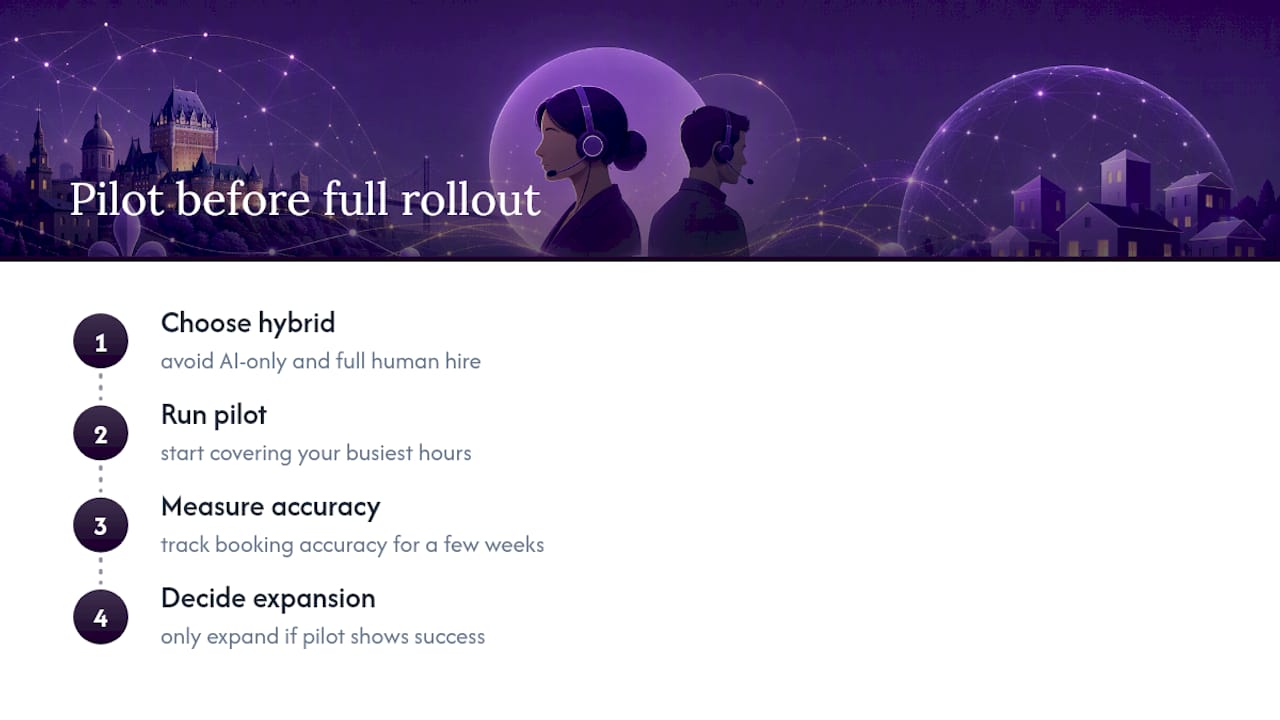
I'd steer most Canadian SMBs toward a hybrid setup before either extreme. Pure AI-first coverage undersells itself on complex or emotionally charged calls, and a full human bilingual hire is expensive insurance against a problem that, for most businesses, shows up only a few hours a week.
The mistake I see most often is skipping the pilot and jumping straight to full 24/7 deployment. That's how integration gaps and shaky French fluency go unnoticed until a customer complains. Start with your busiest hours, measure booking accuracy for a few weeks, and only then decide whether to expand. A measured pilot costs you almost nothing and tells you exactly what a big upfront hire never could.
— James
Ready to stop losing bookings to voicemail?
If you've been weighing an in-house bilingual hire against subscription and per-call options, another path is 24/7 English/French call coverage with appointment booking, CRM and calendar integrations, and SMS confirmations built in from day one, operating on Canadian infrastructure. Every checklist item covered here, language fluency, integration depth, escalation routing, is built into the setup rather than left for you to configure.
Restaurants can see how it handles reservation rushes on the restaurant-specific page, while contractors and service businesses can check the service business integrations built for dispatch and quote intake. If you want to see it handle a real bilingual call before committing to anything, book a demo and bring your toughest French-first scenario.