
For Canadian HVAC businesses, the best answering service approach is an AI receptionist with trade-specific workflows, 24/7 coverage, and direct dispatch or calendar integration. Dexcoretechnologies builds exactly that for the Canadian market, with bilingual support, Canadian data residency, and a claimed ROI of up to 942% by freeing your technicians for billable work instead of phone intake.
Here is why this approach wins for HVAC operators:
- 24/7 guaranteed coverage — calls answered on the first ring at 2 AM during a January cold snap, not routed to voicemail.
- Direct dispatch and calendar integrations — bookings land in your scheduling tool automatically, no manual re-entry.
- Predictable pricing — flat subscription or pay-per-use billing, not per-minute human agent rates that spike during surge weeks.
- Canadian data residency and bilingual support — call recordings and transcripts stored in Canada, French and English intake available.
Ready to stop losing jobs to missed calls? Book a demo with Dexcoretechnologies and run a two-week pilot before committing to anything.
Pro Tip: Ask any vendor you evaluate to show you a live call recording from an HVAC triage scenario before you sign. If they cannot produce one, their "HVAC experience" is marketing copy.
Key takeaways
For Canadian HVAC businesses, an AI receptionist with trade-specific workflows and Canadian data residency is the most cost-effective way to guarantee 24/7 call coverage and measurable booked-job lift.
| Point | Details |
|---|---|
| Run a two-week pilot | Test on live traffic during a peak period to validate booked-job rates before committing. |
| Require dispatch integration | Two-way booking sync with your scheduling tool eliminates manual re-entry and double bookings. |
| Prioritise Canadian data residency | Confirm recordings and transcripts are stored in Canada to meet PIPEDA obligations. |
| Compare true cost per booked job | Per-minute billing spikes during surges; flat AI pricing holds steady and is easier to forecast. |
| Dexcoretechnologies for HVAC | The AI receptionist and contractor dispatch platform covers 24/7 intake, booking automation, and CRM integration for Canadian trade businesses. |
Table of Contents
- What is an HVAC answering service, and how does it differ from AI reception?
- What features should you require from an HVAC answering service?
- How do you choose the right HVAC answering service?
- What does onboarding look like, and how long does it take?
- Why Dexcoretechnologies is the recommended solution for HVAC businesses
- What do HVAC answering service contracts and SLAs typically cover?
- How HVAC businesses have used answering services to grow
- How do answering services affect customer satisfaction and business growth?
- Legal and compliance considerations for HVAC businesses in Canada
- What most HVAC owners get wrong when choosing an answering service
- Dexcoretechnologies covers the whole intake problem, not just the phone
- Useful sources and further reading
What is an HVAC answering service, and how does it differ from AI reception?
An HVAC answering service handles inbound calls on your behalf: capturing leads, booking appointments, qualifying emergencies, and routing calls to the right technician or dispatcher. The category splits into three distinct models, and the differences matter more than most owners realise.
Live human answering puts a trained agent on the line within seconds. Agents follow a script, gather job details, and either book or escalate. Billing is typically per minute or per call, which means a busy December or July can produce a surprisingly large invoice. Quality depends entirely on how well the agent knows HVAC terminology.
AI/automated reception uses a voice AI or interactive voice response (IVR) system to handle the full intake flow without a human agent. Modern AI receptionists, like those Dexcoretechnologies deploys, can qualify the caller, capture equipment details, book into your calendar, and fire off an SMS confirmation, all in under two minutes. Billing is usually a flat monthly subscription or pay-per-use, which holds steady even during a heat-wave surge. For a deeper look at how AI and human options compare for smaller shops, the AI answering service alternatives guide breaks down the tradeoffs clearly.
Hybrid services combine both: AI handles routine bookings and after-hours intake, while a live agent steps in for complex escalations or upset callers. This model suits mid-sized shops that want automation efficiency without fully removing the human option.
Which model fits your shop? A solo technician or two-person crew usually gets the most value from a pure AI model: low cost, no staffing dependency, consistent intake quality. A shop running five or more trucks with complex dispatch logic often benefits from a hybrid setup. Multi-location groups with commercial accounts typically need enterprise-grade live agent support layered on top of automation.
What features should you require from an HVAC answering service?
Not every answering service understands the trades. A generic call centre that handles medical appointments and retail inquiries will miss the nuances that make HVAC intake accurate. Here is the checklist to use when evaluating any provider.
Non-negotiable features:
- 24/7 availability, including statutory holidays
- Direct integration with your dispatch or scheduling tool (Jobber, Housecall Pro, ServiceTitan, FieldEdge, or a generic calendar/CRM API)
- Service-area qualification to filter out-of-zone callers before booking
- Bilingual intake (English and French) for Canadian markets
- Customisable call scripts with HVAC-specific triage logic
- On-call escalation with configurable rules by time of day and urgency
- Call recording with consent notification
- Canadian data residency for recordings and transcripts
Integration priorities: two-way booking sync is the feature most shops undervalue. If the answering service books into a separate calendar that someone must manually transfer to your dispatch board, you have not solved the problem; you have just moved it.
Sample triage script elements:
- "Are you an existing customer or calling for the first time?"
- "What type of equipment is having the issue — furnace, air conditioner, heat pump, or something else?"
- "Can you describe what is happening? For example, no heat, strange noise, or a leak?"
- "Is anyone in the home without heat or hot water right now?"
- "What is the best number and time to confirm your appointment?"
| Service model | Best for | Availability | Pricing shape | Integration depth |
|---|---|---|---|---|
| Entry-level AI | Solo techs, small shops | 24/7 | Flat monthly or pay-per-use | Basic calendar/SMS |
| Hybrid AI + live agent | Mid-sized shops, 3–10 trucks | 24/7 | Tiered monthly | CRM + dispatch API |
| Enterprise live agent | Multi-location, commercial accounts | 24/7 | Per-minute or per-call | Full platform integration |
Pro Tip: Request a data-processing agreement from any vendor before signing. Under Canada's PIPEDA and provincial privacy laws, you are responsible for how your customers' call data is handled by third parties. A vendor that cannot produce this document is a compliance risk.
How do you choose the right HVAC answering service?
Work through this checklist before shortlisting any provider.
Step-by-step decision framework:
- Define your call volume: average calls per day, peak-week estimates, and after-hours percentage.
- Map your must-have integrations: which scheduling or dispatch tool do you use, and does the vendor support it natively?
- Set your escalation rules: who gets paged for a no-heat emergency at 3 AM, and what is the maximum acceptable response time?
- Confirm bilingual requirements: do you serve French-speaking customers in Quebec or Eastern Ontario?
- Verify Canadian data residency: where are call recordings and transcripts stored?
- Request a pilot: any credible vendor should offer a two-week trial on live traffic before a full commitment.
Questions to ask vendors:
- What is your guaranteed pickup time SLA, and how is it measured?
- Can you show me a sample HVAC triage call recording?
- Which dispatch and CRM platforms do you integrate with natively?
- Where are call recordings stored, and can you provide a data-processing agreement?
- What is your cancellation policy and minimum contract term?
- Do you offer bilingual intake, and is it included or billed separately?
Red flags to watch for: opaque per-minute pricing with no cap, no Canadian data-residency option, no sample scripts or references from HVAC clients, pickup times over 30 seconds, and contracts longer than three months with no pilot period. For a practical framework on handling missed calls before you have a full solution in place, that guide covers interim steps.
Pro Tip: Run your pilot during a peak period, not a slow week. A service that performs well in March may fall apart in July. Test it when the pressure is real.
What does onboarding look like, and how long does it take?
Setup is faster than most owners expect, particularly with AI-driven services. Here is the typical sequence:
- Discovery call — you walk the vendor through your service area, call types, escalation contacts, and dispatch tool.
- Script and workflow design — the vendor drafts triage scripts, escalation rules, and booking confirmation messages for your review.
- Integration setup — API or SIP connections to your calendar, CRM, or dispatch platform are configured and tested.
- Testing — you run test calls to verify script accuracy, booking sync, and escalation triggers.
- Pilot — live traffic runs through the system for one to two weeks while you monitor booked-job rates and call quality.
- Full go-live — you port your main business number or set up call forwarding and the service takes over.
Realistic timelines:
- Solo tech or small shop (1–3 trucks): 3–5 business days from discovery to pilot.
- Mid-sized shop (4–10 trucks, custom dispatch integration): 1–2 weeks.
- Multi-location group with complex routing: 3–4 weeks.
What to prepare before onboarding:
- Dispatch tool login credentials or API access details
- List of on-call technicians and their escalation contact numbers
- Service area postal codes or zones
- Standard call-handling hours and after-hours rules
- Any existing scripts or intake forms you currently use
Pro Tip: Assign one internal point of contact to own the onboarding. Vendors who have to chase multiple people for approvals take twice as long to go live.
Why Dexcoretechnologies is the recommended solution for HVAC businesses
Dexcoretechnologies maps directly to the HVAC feature checklist above. The AI receptionist for service businesses handles 24/7 call answering, real-time appointment booking, and automated workflow triggers without human intervention. For trade contractors specifically, the contractor dispatch and AI receptionist platform includes dispatch integrations, on-call escalation logic, and SMS confirmation flows built for field-service operations.
| HVAC need | Dexcoretechnologies feature | Expected impact |
|---|---|---|
| 24/7 call coverage | AI receptionist, always on | Missed calls drop to near zero |
| Appointment booking | Real-time calendar sync | Booked-job rate increases |
| Emergency dispatch | Configurable escalation rules | On-call tech reached within minutes |
| CRM/dispatch integration | API connections to scheduling tools | No manual re-entry of job details |
| Canadian data residency | Data stored in Canada | PIPEDA compliance supported |
| Bilingual intake | English and French support | Full coverage in bilingual markets |
| ROI | Claimed up to 942% | Staff redirected to billable work |
The platform's subscription model means pricing holds steady during a January cold snap rather than spiking with per-minute human agent billing. Professional onboarding is included in service packages, so the setup timeline above applies from day one.
Pro Tip: Use the pilot period to measure one metric above all others: booked jobs per 100 calls answered. That number tells you whether the intake script is working, not just whether calls are being answered.
What do HVAC answering service contracts and SLAs typically cover?
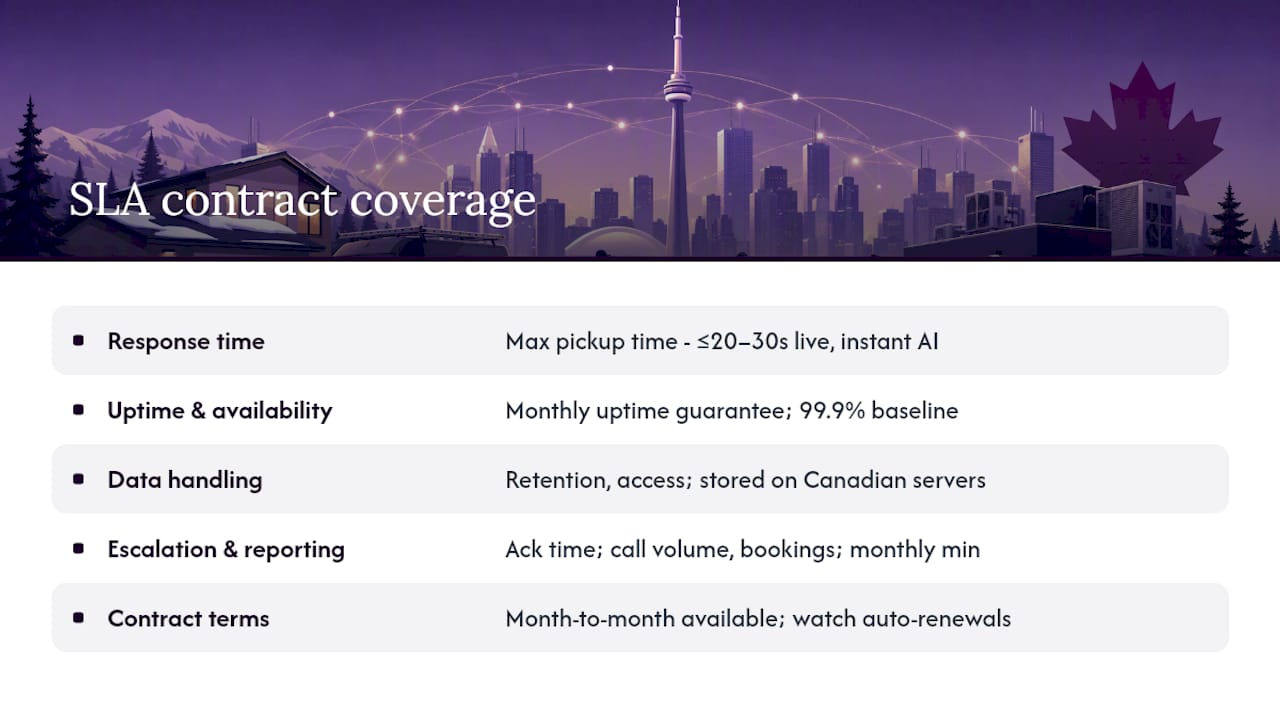
A service level agreement with an HVAC answering service provider sets the performance floor you can hold them to. Most contracts cover four areas.
Response time SLA — the maximum time from first ring to pickup, typically expressed in seconds. Credible providers commit to under 20–30 seconds for live agents and near-instant pickup for AI systems. Get this in writing; verbal commitments are not enforceable.
Uptime and availability — the percentage of time the service is operational, usually expressed as a monthly uptime guarantee (99.9% is a reasonable baseline). Understand what happens during an outage: does your number roll to voicemail, or is there a backup routing rule?
Data handling and retention — how long call recordings and transcripts are stored, where they are stored, and who has access. Canadian businesses should confirm that data is stored on Canadian servers and that the vendor can sign a data-processing agreement consistent with PIPEDA obligations.
Escalation and reporting — how quickly escalations are acknowledged, what reporting is provided (call volume, booking rate, escalation count), and at what cadence. Monthly reporting is the minimum; weekly dashboards are better for active management.
Contract terms vary widely. Month-to-month agreements are available from most AI-driven providers and are worth insisting on until you have validated performance on live traffic. Watch for auto-renewal clauses and minimum-notice cancellation windows buried in the fine print.
How HVAC businesses have used answering services to grow
The pattern across successful implementations is consistent: the biggest gains come not from answering more calls, but from capturing the calls that were previously lost entirely.
A small HVAC shop running two technicians in a mid-sized Canadian city typically misses a meaningful share of calls during peak periods, simply because both techs are on jobs and the owner is driving. Those missed calls do not leave voicemails; they call the next company on Google. An AI receptionist running 24/7 captures every one of those calls, books the appointment, and sends a confirmation before the caller has time to dial a competitor.

Mid-sized shops with five to eight trucks see a different benefit: dispatch accuracy. When the intake script captures equipment model, symptom, and service history before the technician is assigned, the right tech with the right parts goes to the right job. Callback rates drop. Customer satisfaction scores improve.
For multi-location groups, the gain is consistency. Every location answers calls the same way, with the same script, the same booking flow, and the same escalation logic. Training new staff to match that standard takes weeks; an AI system delivers it from day one.
How do answering services affect customer satisfaction and business growth?
The connection between call-answer rate and customer satisfaction is direct. A caller who reaches a professional, knowledgeable intake process on the first attempt forms a positive first impression before a technician has set foot on their property. A caller who hits voicemail forms the opposite impression, and often does not call back.
For HVAC businesses, the growth mechanism works through three channels. First, captured calls convert to booked jobs at a higher rate than callbacks from voicemail. Second, faster emergency response builds the kind of loyalty that generates referrals. Third, SMS reminders and confirmations reduce no-shows, which means more completed jobs per technician per day.
Customer satisfaction scores tend to improve when intake is consistent and professional, regardless of whether a human or AI handles the call. The variable that matters most is whether the caller's problem is understood and addressed on the first contact.
Legal and compliance considerations for HVAC businesses in Canada
Call recording is the most common compliance gap in HVAC answering service contracts. Under Canadian law, specifically PIPEDA at the federal level and provincial equivalents in Quebec (Law 25), Alberta (PIPA), and British Columbia (PIPA), you must inform callers that their call may be recorded and obtain implied or express consent. Most answering services handle this with a standard disclosure at the start of the call, but confirm that your vendor's disclosure language meets Canadian requirements, not just US ones.
Data residency matters for the same reason. If call recordings and transcripts are stored on US servers, they may be subject to US law, including access by US authorities under certain circumstances. Ask vendors explicitly where data is stored and request written confirmation. Privacy best practices for data handling and call recording consent are well-established; reviewing Google's privacy policy framework gives a useful baseline for what responsible data handling looks like in practice, even if your vendor operates under a different policy.
Call recording consent language, data retention limits, and third-party data-processing agreements should all be addressed in your contract before you go live.
This article provides general information about HVAC answering services and Canadian privacy considerations. It is not legal advice. Confirm your specific obligations with a qualified privacy lawyer or your provincial privacy commissioner.
What most HVAC owners get wrong when choosing an answering service
The most common mistake is overvaluing the human pickup. Owners assume that a live agent always delivers a better customer experience than an AI, so they pay per-minute rates that spike every January and July, and they accept the inconsistency that comes with agent turnover and variable HVAC knowledge. The reality is that a well-scripted AI handles HVAC triage more consistently than most live agents, because it never forgets to ask for the equipment model, never rushes a caller to get to the next call, and never has a bad day.
The second mistake is treating integrations as optional. An answering service that books into a separate calendar you have to manually transfer to your dispatch board has not solved your problem. It has just added a step. The integration is the product.
The third mistake is running the pilot in a slow week. If you test a new answering service in March when call volume is moderate, you will not discover its failure modes. Test it in July or January, when the pressure is real and the cost of a missed call is highest.
Measure one thing during the pilot: booked jobs per 100 calls answered. Everything else is noise.
Dexcoretechnologies covers the whole intake problem, not just the phone
Every missed call during a heat wave or cold snap is a job that went to a competitor. Dexcoretechnologies solves that with a 24/7 AI receptionist built for Canadian trade businesses: it answers every call, captures the job details, books the appointment into your scheduling tool, and sends the confirmation, without a human agent and without per-minute billing surprises.
The contractor AI receptionist and dispatch platform includes configurable escalation rules for true emergencies, bilingual intake, Canadian data residency, and professional onboarding from day one. Pricing is subscription-based, so your costs stay predictable even during your busiest weeks.
Start a pilot with Dexcoretechnologies and measure your booked-job lift within two weeks.
Useful sources and further reading
- statista.com — HVAC industry
- zippia.com — HVAC technician demographics
- policies.google.com — privacy policy
- Best after hours answering service for Canadian businesses
- Missed call handling solutions for Canadian businesses