
What are the top CRM integration providers in Quebec?
The strongest options for Quebec businesses in 2026 are Botpress, TCM Conseils, and CRM QUÉBEC. Each takes a different angle, so the right pick depends on whether you need a self-serve AI platform, custom programming, or hands-on CRM consulting.
CRM integration tools connect your customer relationship management system to other business applications, automating data flow and eliminating manual entry. When done well, your CRM becomes a single source of truth across sales, marketing, and service.
| Provider | Services offered | Specialisation | Certifications | Best for | Rating |
|---|---|---|---|---|---|
| Botpress | AI helpdesk, multi-step workflow automation, ticket resolution | AI-native customer support automation | SOC II, GDPR, KPMG penetration tested | Businesses wanting automated support without per-seat costs | 4.3★ (22 reviews) |
| TCM Conseils | AI automation, chatbot integration, CRM task automation, API programming | AI process transformation and API integration | Not publicly listed | Custom AI automation and integration programming in Quebec | 5★ (12 reviews) |
| CRM QUÉBEC | CRM consulting, efficiency diagnostics, sales coaching, ERP/MRP consulting, web solutions | CRM optimisation and sales coaching | Not publicly listed | Quebec businesses needing CRM diagnostics and coaching | — |
How do these providers compare in depth?
Botpress
Botpress is an AI-native helpdesk built to automate customer support without charging per seat. For example, Botpress costs $9,000 per year for 25 seats and 1,200 conversations per month, with no per-seat cost. The platform handles multi-step workflows, proactive customer outreach, and ticket resolution without human intervention. For compliance-conscious teams, it carries SOC II certification, GDPR compliance, and penetration testing by KPMG. That combination of price transparency and verified security credentials is rare at this tier.
Key capabilities:
- Multi-step workflow automation triggered by customer actions
- AI agents that resolve tickets without escalating to staff
- Proactive outreach workflows for follow-ups and notifications
- No per-seat cost model, which keeps costs predictable as teams grow
TCM Conseils
TCM Conseils serves Quebec businesses that need custom-built AI automation rather than an off-the-shelf platform. Their work spans AI automation processes and API programming, chatbot integration for websites and social media, CRM task automation, and functional and business analysis. Pricing is not publicly listed, which is typical for consulting engagements scoped to each client's complexity. If your integration involves non-standard systems or enterprise process transformation, TCM Conseils is worth a direct conversation.
CRM QUÉBEC
CRM QUÉBEC focuses on getting more out of the CRM you already have. Their CRM consulting covers efficiency diagnostics, sales coaching, ERP/MRP tool advice, and web solution development, all tailored to Quebec companies. This is the right fit when the problem is not the technology itself but how your team uses it.
How do you choose the right CRM integration tool or consultant?
The decision comes down to three factors: complexity of your systems, your internal technical capacity, and budget structure.
Simple trigger-action platforms like Zapier suit small and mid-sized businesses with basic CRM needs. Complex enterprise environments, where bidirectional data sync and error handling matter, require a proper iPaaS solution. Low-code tools like Microsoft Power Platform let you start incrementally without large upfront investment, which reduces risk and improves adoption. For Dynamics 365 users specifically, the Power Platform is a natural starting point before committing to a custom build.
Questions to ask any vendor or consultant before signing:
- Which specific CRM platforms and third-party systems have you integrated before?
- How do you handle bidirectional sync and error management when data conflicts arise?
- What does your post-launch support look like, and is it included?
- Do you have compliance credentials relevant to Canadian data privacy requirements?
- What is your typical project timeline for an integration of our scope?
Red flags to watch for:
- No clear process for testing data accuracy before go-live
- Vague answers about how API limits or rate throttling are handled
- Pricing tied entirely to event volume with no cap, which creates billing surprises
- No local knowledge of Quebec's business environment or compliance context
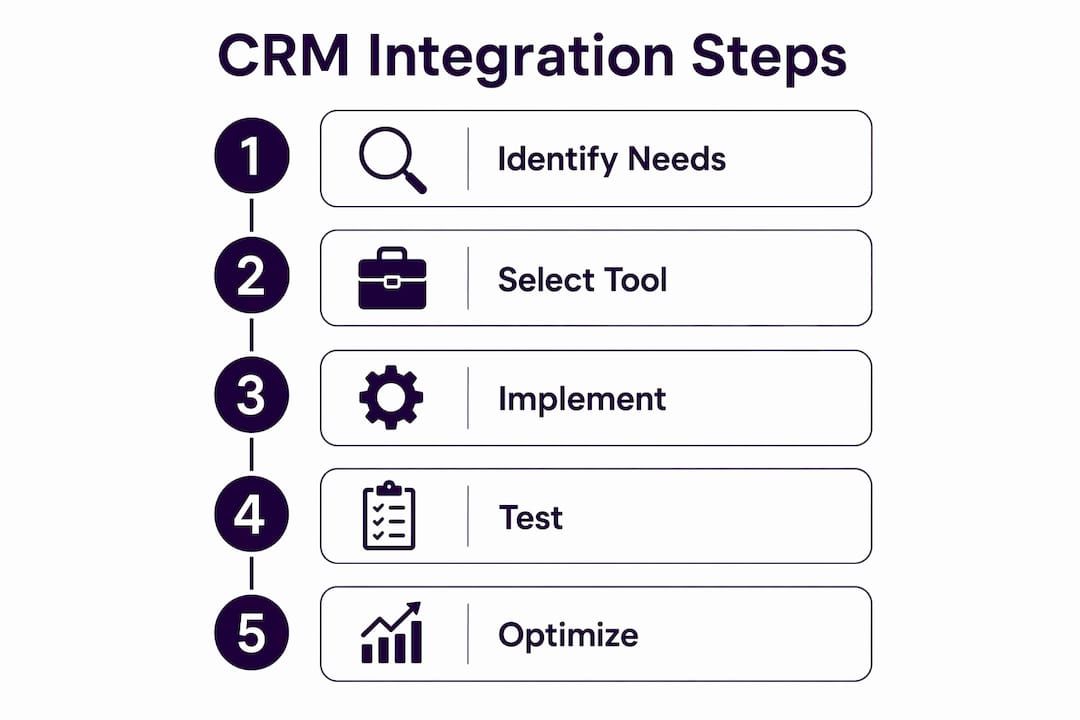
Pro Tip: Start with a workflow automation audit before selecting a tool. Map every system your team touches daily, then identify which connections cause the most manual work. That list becomes your integration priority, and it prevents you from buying a platform that solves the wrong problem.
Typical timelines vary considerably. Simple integrations using pre-built connectors can go live in days or a few weeks. Custom API builds involving data transformation and enterprise systems often take several months. Local Quebec providers tend to shorten the feedback loop on requirements, which can meaningfully reduce that timeline.
What is CRM integration and why does it matter for Canadian businesses?
CRM integration is the process of linking your CRM platform to other business systems, such as email, ERP, marketing automation, and accounting, so that data syncs automatically between them. The result is a single, accurate view of every customer across every department.

Without integration, data silos form between disconnected systems. Sales works from one dataset, marketing from another, and service from a third. Errors multiply, opportunities fall through the gaps, and AI tools get fed incomplete data that produces unreliable outputs.
The four main categories of integration tools:
- Native integrations: Built directly into your CRM, minimal setup required, limited to what the vendor supports
- Third-party connectors: Marketplace apps like Zapier or Make that bridge your CRM to hundreds of other tools
- API-based integrations: Custom-built connections for specialised needs, including automated calendar sync and telephony logging
- iPaaS middleware: Platforms like MuleSoft or Boomi that act as a central hub for complex, multi-system environments
Concrete examples of what integration actually looks like in practice: syncing your online calendar so appointments booked anywhere appear instantly in your CRM, or linking your VoIP system so every call is logged automatically with the customer record. These are not advanced use cases. They are the baseline that most Quebec businesses are still doing manually.
For Canadian businesses, local compliance considerations add a layer that generic platforms often miss. Quebec's Law 25 on personal information protection creates specific obligations around how customer data is collected, stored, and shared across integrated systems. A consultant or platform with Canadian market experience is better positioned to build integrations that satisfy those requirements from the start, rather than retrofitting compliance after the fact.
Unified API platforms also reduce long-term maintenance burden by centralising updates. When a third-party system changes its API, a unified layer absorbs that change in one place rather than requiring fixes across every individual connector.
Dexcoretechnologies: a different approach to CRM-connected automation
If the providers above are solving a data integration problem, Dexcoretechnologies is solving a lead capture problem. Missed calls and unbooked appointments are revenue losses that no CRM integration fixes on its own, because the data never enters the system in the first place.
Dexcoretechnologies offers 24/7 AI answering for Canadian service businesses, with real-time appointment booking, lead capture, and CRM integration built into the workflow. Every call gets answered, every customer detail gets captured, and the information flows directly into your CRM without manual entry. For restaurants, contractors, clinics, and transport operators, that means no lead slips through simply because a phone went unanswered. The platform also handles SMS confirmations, team notifications, and dispatch routing, so the automation extends well beyond the initial call. If you are evaluating customer service automation alongside your CRM integration project, Dexcoretechnologies is worth adding to that conversation.
Key takeaways
The strongest CRM integration outcome combines the right tool category with a provider who understands your systems, your compliance obligations, and your team's actual capacity to adopt new workflows.
| Point | Details |
|---|---|
| Match tool to complexity | Zapier suits basic SMB needs; iPaaS platforms like MuleSoft handle enterprise bidirectional sync and error management. |
| Compliance matters in Quebec | Law 25 creates specific data obligations; choose a provider with Canadian market experience to build compliant integrations from the start. |
| Botpress pricing benchmark | Botpress costs $9,000 per year for 25 seats and 1,200 conversations per month, offering a transparent, no-per-seat cost model with SOC II and GDPR credentials. This provides cost-effective and predictable support expenses for businesses. |
| Start with an audit | Map every manual data touchpoint before selecting a platform; this prevents buying a solution that addresses the wrong bottleneck. |
| Dexcoretechnologies fills the gap | For businesses losing leads to missed calls, Dexcoretechnologies adds 24/7 AI answering and CRM-connected lead capture before integration tools can do their job. |