
The two most relevant automated dispatch software providers serving Canadian operations managers right now are Dispatch Technologies, built for enterprise field service orchestration, and Alcom Electronic Communications Ltd., which specialises in public safety and government CAD systems. Neither is a general-purpose tool you can swap in overnight, and choosing the wrong one costs more than the licence fee.
Automated dispatch software uses AI to assign jobs, route technicians, and reschedule in real time as conditions change. The core difference from a basic scheduling tool is that it evaluates multiple variables simultaneously, including technician skills, vehicle capacity, location, and traffic, and adapts continuously rather than working from a static plan.

| Provider | Primary Service | Target Industry | Key Features | Real-Time Updates | Resource Management | Integrations | Support & Onboarding | Rating |
|---|---|---|---|---|---|---|---|---|
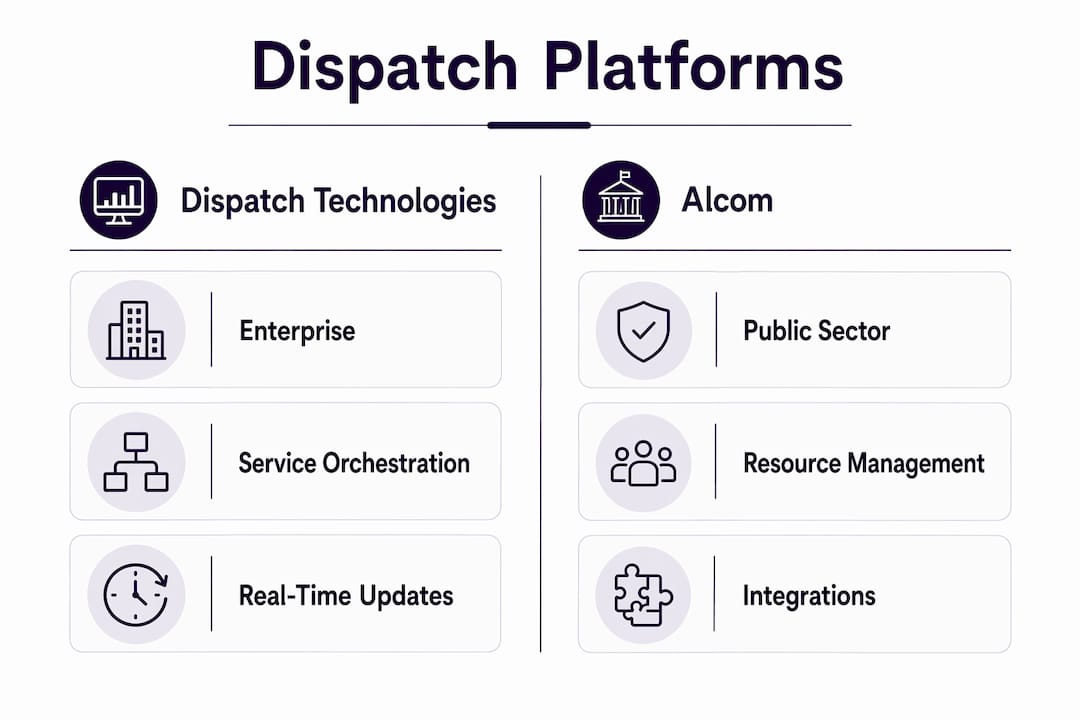
| Dispatch Technologies | Enterprise service orchestration | Field service enterprises, contractor networks | Scheduling, routing, performance analytics, communication channels | Real-time visibility across owned and contractor fleets | Provider performance tools, cost-saving insights | CRM, ERP, field service platforms | Onboarding for new service providers included | 5★ (16 reviews) |
| Alcom Electronic Communications Ltd. | Public safety dispatch and radio communications | Government, public safety, security agencies | CAD systems, NG9-1-1 call handling, radio dispatch, surveillance, records management | Real-time CAD and radio dispatch | Command and control software, records management | P25 radio, VESTA NG9-1-1, Spillman Flex, CommandCentral | Specialised public safety implementation support | 5★ (3 reviews) |
How do these two Canadian dispatch platforms actually compare?
Dispatch Technologies and Alcom serve genuinely different problems, so the comparison is less about which is better and more about which fits your context.
Dispatch Technologies positions itself as a service orchestration layer for enterprises managing both employed technicians and third-party contractors. Its platform gives operations managers real-time visibility into every job, regardless of who is doing the work. The scheduling and routing engine handles advanced assignment logic, and the performance analytics tools let you monitor contractor quality the same way you would an in-house team. For a Manitoba utility company or a national HVAC chain managing subcontractors across the province, that contractor-visibility capability is the differentiator.

Alcom Electronic Communications Ltd. operates in a different category entirely. Its Computer-Aided Dispatch systems, NG9-1-1 call handling software, and radio dispatch infrastructure are built for public safety agencies, municipal governments, and security operations. The product catalogue includes Spillman Flex police software, VESTA NG9-1-1 solutions, CommandCentral, and a full radio infrastructure stack covering P25, MOTOTRBO, and analogue two-way systems. If you are running a dispatch centre for emergency services or a government communications network, Alcom's depth in that vertical is hard to match from a general-purpose vendor.
Key differentiators at a glance:
- Dispatch Technologies: real-time contractor performance monitoring, integrated communication channels, cost-saving analytics, enterprise scheduling and routing
- Alcom Electronic Communications Ltd.: CAD and NG9-1-1 systems, radio dispatch infrastructure, surveillance and access control, records management, body-worn video, public safety DAS
Neither platform publishes pricing publicly. Both require direct engagement to scope a deployment, which is standard for enterprise and public safety dispatch systems.
How to choose the right dispatch management software for your operation
The selection criteria that matter most depend on your workforce type, your existing systems, and your regulatory environment.
Real-time AI scheduling and rerouting is the baseline. Any platform worth considering should continuously re-optimise as conditions change, not just generate a morning plan and leave dispatchers to manage exceptions manually. For Manitoba operations, that means weather-aware rescheduling is a practical requirement, not a nice feature.
Integration with existing systems is where most implementations succeed or fail. The cleanest approach is to connect AI layers via APIs to your current CRM, ERP, or TMS rather than replacing everything at once. This phased strategy reduces risk and lets you automate core workflows before scaling.
Workforce model fit matters more than most buyers realise. If you manage a blended workforce of employees and contractors, you need a platform that handles both under one scheduling and performance layer. Dispatch Technologies is built for exactly that. If your operation is purely internal and public-safety-focused, Alcom's CAD infrastructure is the appropriate fit.
Canadian data privacy compliance should be confirmed before signing. Verify that any platform stores and processes data in accordance with PIPEDA and, where applicable, Manitoba's PHIA for health-adjacent operations.
Technical constraints also deserve early scrutiny. Some on-demand dispatch platforms carry hard limits, such as a 200-mile maximum between drivers and assigned tasks, or a single concurrent auto-dispatch process per team. These constraints can break a deployment if discovered after go-live.
Essential features to confirm before committing:
- AI-driven, constraint-based job assignment (skills, certifications, location, capacity)
- Dynamic rescheduling triggered by real-world disruptions, not manual dispatcher intervention
- Open API architecture for CRM, ERP, and GPS integration
- Scalability to handle seasonal volume spikes without manual configuration changes
- Blended workforce support if you use contractors alongside employed staff
- Audit trails and data residency options for Canadian compliance
Pro Tip: Before evaluating vendors, map your current dispatch workflow and identify the three highest-friction points. A platform that solves those three specifically will outperform a feature-rich system that addresses none of them directly. Bring that list to every demo.
What does automated dispatch software actually do?
At its core, dispatch management software replaces the manual process of matching jobs to workers with an AI engine that evaluates constraints simultaneously and assigns tasks in seconds. Switching from manual to automated dispatch reduces errors, cuts labour costs, improves fleet visibility, reduces empty miles, and speeds response times.
The technology stack behind a modern dispatch platform typically includes:
- Automated order-to-driver assignment: matches jobs to workers based on skills, certifications, vehicle type, proximity, and delivery windows
- Multi-constraint route planning: factors in traffic, road restrictions, load optimisation, driver hours, and customer time windows simultaneously
- Real-time rescheduling: detects disruptions like cancellations or delays and triggers automatic rebalancing without rebuilding the entire schedule
- Geospatial dashboards and live tracking: gives dispatchers a real-time view of fleet positions, ETAs, and exception alerts
- Predictive demand modelling: uses historical data, weather, and event feeds to forecast demand surges and flag under-capacity zones before they become problems
- Multi-fleet and carrier orchestration: manages owned vehicles and third-party carriers from a single interface
The operational benefits are concrete. AI processes complex constraints rapidly, dynamically rerouting technicians as conditions change, which directly improves first-time fix rates and reduces the number of return visits. Better route planning also cuts fuel consumption and technician travel time. One documented example from the field service sector: Electrolux reduced technician travel time by 15% and saved $1M annually through criteria-based scheduling.
AI dispatch in Canada: what the evidence shows
The strongest case for AI-powered dispatching is not the technology itself but what it does to the dispatcher's role. AI dispatching empowers dispatchers to focus on complex problem-solving and strategic fleet command while automation handles routine task assignment. Instead of spending a shift manually slotting jobs, a dispatcher using a well-configured AI platform spends that time on exceptions, escalations, and scenario planning.
For Canadian operations specifically, weather-aware real-time re-optimisation is a practical necessity. A platform that cannot adapt to a sudden winter storm closing a highway through northern Manitoba is not a dispatch platform; it is an expensive scheduling spreadsheet.
Key data-backed insights on automation ROI:
- Automated dispatching improves loading space utilisation and speeds response to unexpected requests, reducing wasted capacity across fleets
- Hybrid human-AI dispatch models let technical teams override AI decisions using what-if impact analysis, preserving dispatcher authority without sacrificing speed
- Phased API-driven integration reduces implementation risk and accelerates time to value compared to full system replacements
- Improved first-time fix rates and reduced return visits directly lower per-job costs in field service operations
Dexcoretechnologies offers a complementary angle on this for Canadian service businesses. Its AI dispatch and answering service covers 24/7 call handling, appointment booking, and workflow automation with CRM, calendar, and dispatch integrations, targeting the front-end of the dispatch cycle that platforms like Dispatch Technologies and Alcom do not address.
Dexcoretechnologies: a different path to dispatch automation
If the enterprise platforms above are more than your current operation needs, Dexcoretechnologies offers a leaner entry point to dispatch automation for Canadian service businesses, contractors, and transport operators.
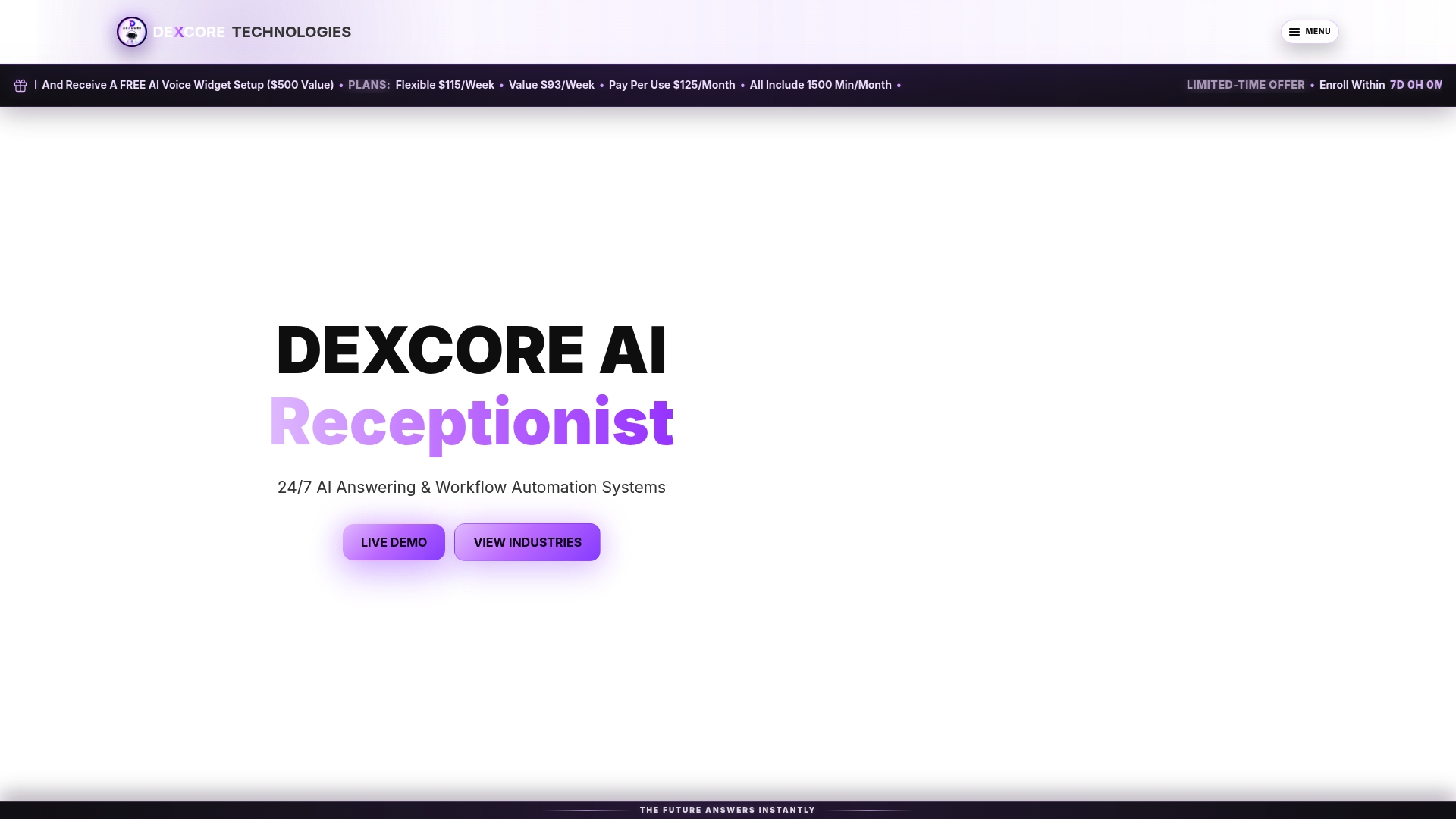
The practical difference is scope. Dispatch Technologies and Alcom solve complex, large-scale orchestration and public safety dispatch. Dexcoretechnologies solves the problem that happens before a job ever reaches the dispatch board: missed calls, unbooked appointments, and leads that fall through because no one answered at 9 PM on a Tuesday. Its AI receptionist for service businesses handles 24/7 call coverage, real-time booking, lead capture, and team notifications, then routes the confirmed job into your existing dispatch or CRM system. For a Manitoba contractor or delivery firm that does not need a full CAD system but does need every inbound call converted, that is a meaningful gap to close.
Key takeaways
Automated dispatch software delivers the most value when the platform matches your workforce type, integrates with your existing systems via API, and adapts in real time to Canadian operating conditions.
| Point | Details |
|---|---|
| Match platform to use case | Dispatch Technologies suits enterprise field service; Alcom suits public safety and government CAD. |
| Prioritise real-time rerouting | Weather-aware, dynamic rescheduling is a practical requirement for Manitoba operations, not an optional feature. |
| Integrate via API first | Connecting AI layers to existing CRM or ERP systems reduces risk and speeds time to value. |
| Check technical constraints early | Hard limits like distance caps or single concurrent dispatch processes can break a deployment if found after go-live. |
| Dexcoretechnologies for front-end automation | For service businesses needing 24/7 call handling and booking automation that feeds into dispatch, Dexcoretechnologies is the Canadian-built alternative. |