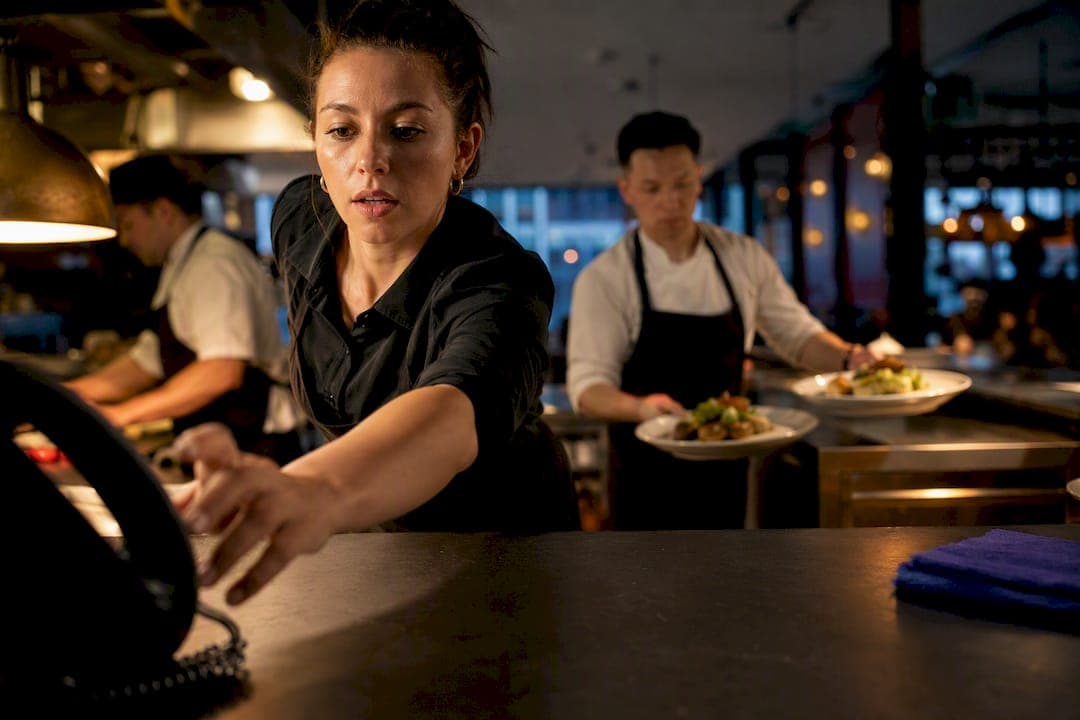
The fastest fix for a restaurant takeout call overflow problem is 24/7 automated call coverage from an AI receptionist, paired with a short staff rule set for peak hours. Industry data on missed-call losses and the routing logic behind platforms like DEXCORE's restaurant AI receptionist both point the same direction: automation catches what rings on hold. The checklist below shows exactly how to set it up before your next rush.
TL;DR:
- Automating overflow calls with a 24/7 AI receptionist is the most reliable way to prevent missed takeout orders and reservations during peak hours.
- Setting the ring threshold to two to four rings and configuring seamless call handoff minimizes caller frustration and error rates.
- Integration with POS and reservation systems ensures accurate ticket creation and prevents duplicate profiles or double bookings.
- Regular testing, staff training, and clear scripts are essential to optimizing the automation setup before busy periods.
- Using SMS confirmations and real-time ETA updates enhances customer satisfaction and reduces callback inquiries.
Table of Contents
- Solution categories that actually stop lost takeout calls
- How overflow handling works in practice
- Integrations and workflows to connect calls with orders and POS
- Implementation checklist and configuration for takeout peak windows
- Measuring impact: KPIs and the business case for overflow handling
- How Dexcoretechnologies implements restaurant workflows that prevent lost takeout calls
- What call overflow is and why it spikes during dinner rushes
- The business cost of missed takeout and reservation calls
- Training staff or virtual agents for overflow calls
- Customer experience during overflow: keeping callers calm and satisfied
- A quick story from the floor
- Get takeout overflow handled before your next rush
- Further resources on call handling and reservations
- Sources
Solution categories that actually stop lost takeout calls
Restaurants have four real options for handling overflow, and they are not interchangeable.
AI receptionist / virtual receptionist. This is the only option built for permanent coverage. It answers every call, collects the order details or reservation request, and routes the ticket to your POS or a staff dashboard. Setup takes longer than flipping on call forwarding, but it is the only category that works identically at 6:15 PM on a Tuesday and 7:45 PM on a Saturday.
Call forwarding and overflow staffing. Routing extra calls to a manager's cellphone or a second host station is cheap to start and painful to scale. Someone still has to answer, write down the order by hand, and walk it to the kitchen. Every extra call during a rush competes directly with the person taking it for time at the pass.
Auto-attendant plus an ordering link or SMS. A recorded menu ("press 1 for hours, press 2 for the online order link") deflects the easy questions and texts a link for people who just want to place an order themselves. It solves maybe a third of the problem: simple queries, not complex substitutions or large group orders.
Hybrid coverage. Automation handles the 5:00 to 8:30 PM crunch; a live host takes calls the rest of the day. This is where most mid-volume takeout operations land once they've tested pure automation and pure staffing separately.
Pick based on four factors:
- Call volume: under 20 takeout calls a night, staffing might hold; above that, it usually breaks down.
- Budget: forwarding is free but costs staff time; automation has a subscription cost but no labour drag.
- Integration need: if your POS already handles online orders, phone automation should feed the same queue.
- Staffing reality: a two-person kitchen answering the phone is a two-person kitchen not cooking.
How overflow handling works in practice
Overflow handling is really three mechanical decisions stacked together.
- Ring threshold. Most systems trigger the overflow handler after two to four rings unanswered at the primary line. Set it too high and callers hang up before the automation ever picks up; set it too low and you route routine calls away from staff who could have answered in five seconds.
- Seamless handoff. The caller should never hear a jarring transfer or a second dial tone. A well configured system picks up as though it were the primary line, so no one on the other end knows a rush is happening.
- Triage. Every call gets sorted, usually into three buckets, takeout order, reservation request, or general question, and routed accordingly. A takeout order goes to the kitchen queue; a reservation goes to the booking system; a general question ("are you open on Family Day?") gets answered on the spot.
- Capture and delivery. The system logs name, order or party size, and callback number, then pushes that ticket to staff by SMS, a live dashboard, or directly into the POS as a ticket. The goal is zero manual re-entry between the phone call and the kitchen printer.
Integrations and workflows to connect calls with orders and POS
The integration that matters most is the one that stops a captured call from turning into a second data-entry job.
Reservation platforms such as OpenTable and Resy already hold guest history and table availability, so routing a phone reservation straight into that system avoids double booking and duplicate guest profiles. On the ordering side, POS integration is what actually prevents a lost order: a captured phone call should generate a kitchen ticket or pickup-queue entry the same way an app order does, not a sticky note by the printer.
A few integration priorities worth locking down early:
- SMS confirmations sent immediately after a call, so the customer has a record of pickup time without calling back to check.
- Automated ETA updates when a kitchen falls behind, which cuts the "is my order ready yet" callback volume significantly.
- Delivery platform connectors or a manual dispatch handoff for orders that need a driver rather than a curbside pickup.
- A call triage workflow that separates takeout tickets from reservation requests before either hits a human.
Skip any of these and you're just moving the bottleneck from the phone line to the kitchen counter.
Implementation checklist and configuration for takeout peak windows
Standing up overflow protection is a half-day project if you follow it in order, not a multi-week rollout.
- Set your coverage windows and ring thresholds. A typical takeout-heavy restaurant enables overflow during peak dinner hours on weekdays and extends coverage on weekends; ring threshold is set to a few rings to balance caller experience and timely answering.
- Map the call flows. Write two short scripts, one for takeout orders (name, order, pickup time, callback number) and one for reservations (party size, date, time, special requests). Keep both under 30 seconds of back and forth.
- Configure the POS and reservation integrations. Test end to end: place a mock takeout call and confirm a real ticket lands in the kitchen queue, not just in an inbox.
- Train staff on the new notification flow. Show them where captured orders appear, whether SMS, dashboard, or ticket printer, and what to do if a ticket looks wrong.
- Run demo calls before the first live rush. Ten to fifteen mock calls covering odd orders, group reservations, and rapid-fire back-to-back calls will surface most configuration gaps.
- Set a fallback plan. If automation drops or misroutes a call, have a manager callback protocol and an SMS order link ready as backup.
- Maintain a recurring test schedule. Once a week is enough to catch drift after a menu change or a POS update.
Pro Tip: Run your first ten test calls back to back, not spaced out. That's the only way to see how the system behaves under the exact kind of pressure a Friday dinner rush actually creates.
Measuring impact: KPIs and the business case for overflow handling
Five numbers tell you whether overflow handling is working: answer rate, abandoned-call rate, captured-order rate, callback completion rate, and recovered order value.
A simple estimate works well for the business case: multiply your average takeout ticket by the number of calls you were previously missing during peak windows, then by the days per week those windows run. If you were missing calls at night at an average ticket value across peak nights, that's a significant amount of revenue potentially lost each week before any recovery.
Restaurants that measure answer rate and abandoned-call rate side by side typically find the gap between them narrows fast once overflow handling launches, since most "missed" calls were never truly abandoned, they were just ringing into nothing.
Set a target after the first month: aim for a captured-order rate that mirrors your online-order completion rate. Review daily digests for spot checks and hold a weekly KPI review to catch slow drift before it becomes a pattern.
How Dexcoretechnologies implements restaurant workflows that prevent lost takeout calls
Some companies build restaurant-specific automation around the same mechanics covered above: 24/7 AI answering, booking automation, and workflow routing that pushes captured calls into existing systems rather than a separate inbox.
What the restaurant AI receptionist product page describes, and what to verify during any vendor demo:
- POS integration that turns a phone order into a real kitchen ticket, not a message someone re-types.
- Reservation platform connections that avoid duplicate guest entries.
- SMS confirmation delivery immediately after a call ends.
- A documented onboarding process with configuration support, not a self-serve dashboard with no guidance.
Ask any vendor, Dexcoretechnologies included, to show you a live demo call end to end before signing anything.
What call overflow is and why it spikes during dinner rushes
Call overflow happens when incoming calls exceed the number of staff available to answer them, so calls either go unanswered, go to voicemail, or get abandoned by the caller before anyone picks up. It's a capacity problem, not a technology problem at its root, but technology is what fixes it.
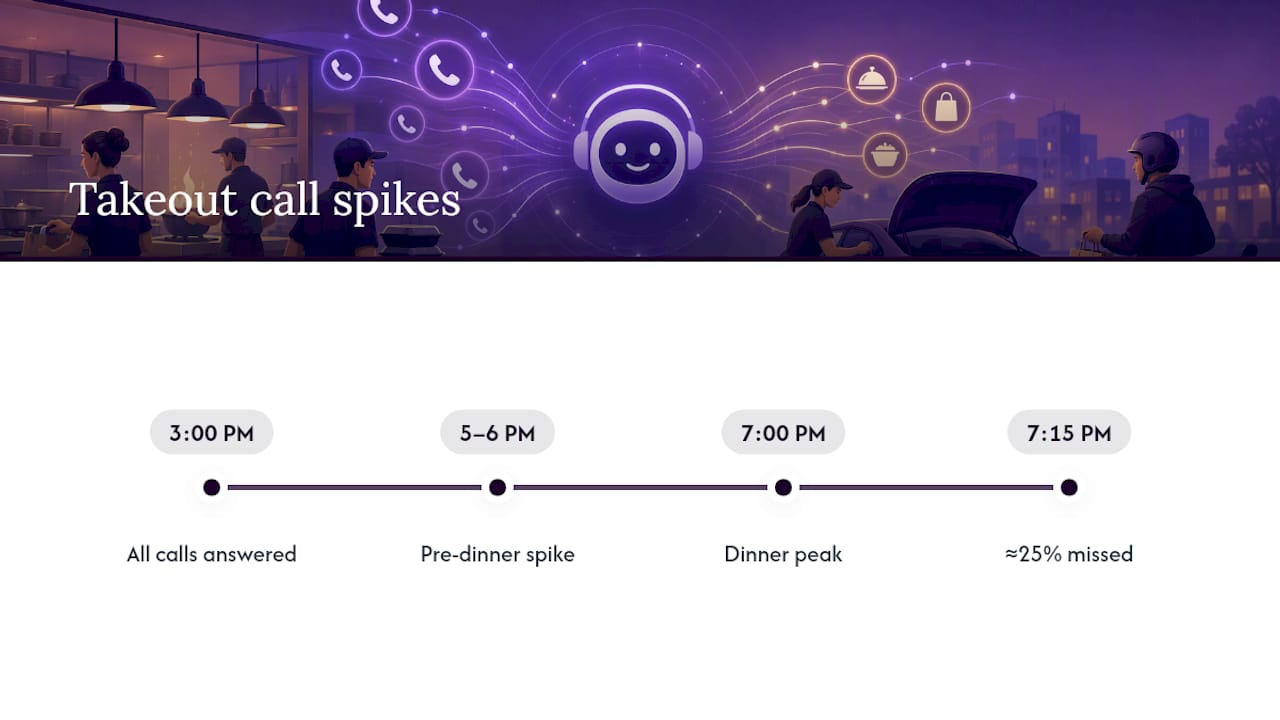
The spike pattern is predictable once you look at it. Takeout call volume clusters tightly around two windows: the 30 to 45 minutes before typical dinner service (5:00 to 6:00 PM) and the peak of dinner service itself (7:00 to 8:00 PM), when the same staff answering phones are also expediting tickets, running food, and seating walk-ins. A restaurant that comfortably answers every call at 3:00 PM can be dropping one in four calls by 7:15 PM, with the exact same phone line and the exact same staff count.
Weekends compound the problem. Friday and Saturday takeout volume often runs significantly above a typical weeknight, but most restaurants don't scale phone coverage to match, they scale kitchen and floor staff instead, treating the phone as an afterthought. That mismatch is precisely where overflow calls go to die.
The business cost of missed takeout and reservation calls
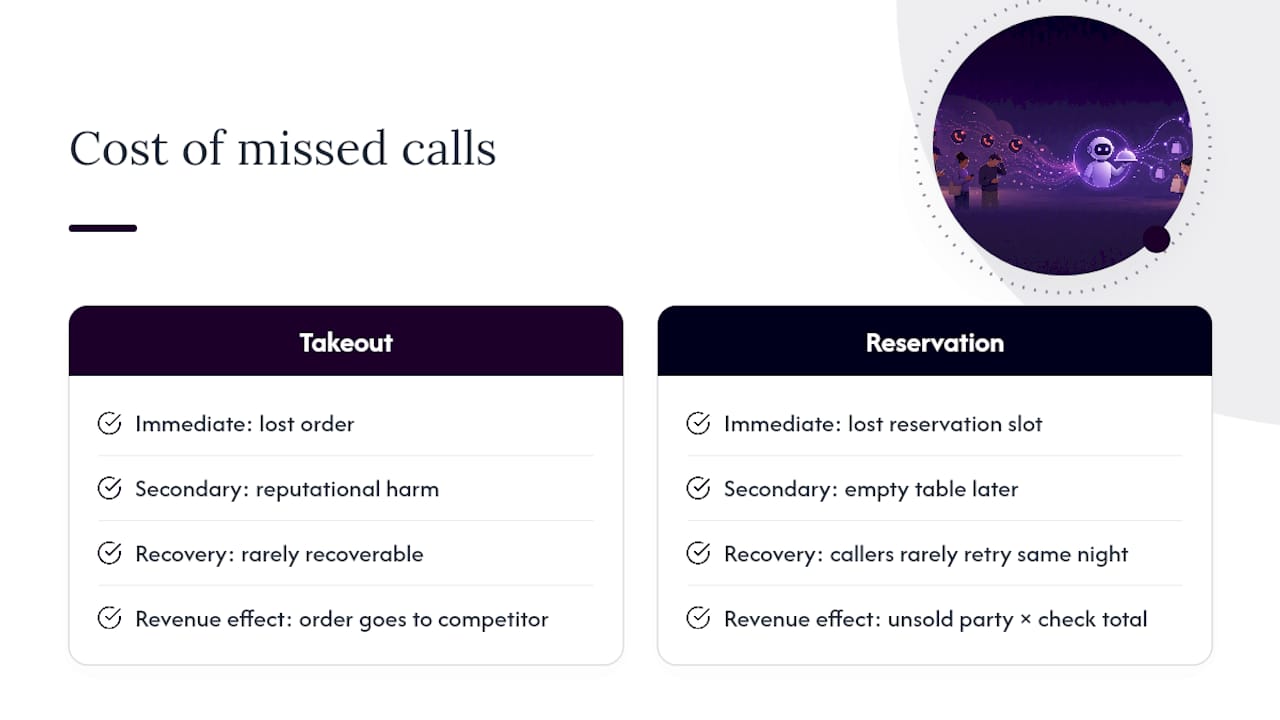
Every missed call is a lost order for most restaurants, not a delayed one. Customers calling a busy restaurant rarely wait on hold or call back. They open a delivery app, call a competitor down the block, or simply decide to cook at home. There's no voicemail follow-up loop that recovers most of that revenue.
The compounding cost is reputational, not just transactional. A caller who gets a busy signal or an unanswered line twice tends to stop trying a third time, and word travels fast in a neighbourhood dining scene where "they never pick up the phone" becomes the thing people repeat to friends. That's harder to reverse than a single lost order.
Missed reservation calls carry a second cost layer: an empty table that could have been filled. Unlike a takeout order, a lost reservation call often means a specific time slot goes unsold entirely, since most callers who can't get through won't try the same restaurant again for that night. Multiply a handful of missed reservation calls by an average party size and check total, and the weekly gap adds up quickly for any restaurant running near capacity on weekends. The direct fix is the same one that solves takeout overflow: consistent, reliable answering during exactly the hours volume peaks, not just whenever staff happen to be free.
Training staff or virtual agents for overflow calls
Whether the overflow handler is a person or an AI receptionist, the quality bar is the same: every call needs the same order-accuracy standard as an in-person interaction.
For live backup staff, the training priority is speed with structure. Give them a fixed intake sequence, name, order, pickup time, callback number, so they're not improvising under pressure. A rushed staff member skipping the confirmation step is where most order errors creep in, not the ordering itself.
For an AI receptionist, the "training" is really configuration: menu items and common substitutions loaded accurately, hours and holiday closures kept current, and escalation rules clear for anything outside its scope (large catering orders, complaints, anything genuinely urgent). The system should hand off to a human immediately when a call doesn't fit its intake pattern, not force a caller through a script that clearly doesn't apply to them.
Both paths need one more thing: a confirmation readback. Whether human or automated, repeating the order and pickup time back to the caller before ending the call catches the majority of mistakes before they reach the kitchen. Skip that single step and error rates climb regardless of who, or what, answered the phone.
Customer experience during overflow: keeping callers calm and satisfied
The single biggest satisfaction driver during overflow isn't speed, it's certainty. A caller who hears "we're at three rings, someone's picking up" experiences the wait completely differently than one hearing dead air or a generic hold tone with no indication anyone is coming.
A few things matter more than most restaurants assume:
- Acknowledge the wait honestly. A brief, natural greeting beats silence or an obviously robotic script, even when the caller is technically speaking to an AI receptionist.
- Never make the caller repeat themselves. If a call gets triaged from automation to a human, that handoff needs to carry the order details with it, not force the customer to start over.
- Confirm pickup time realistically. Promising 15 minutes during a 45 minute rush erodes trust faster than a missed call ever would.
- Send a text confirmation immediately. It gives the caller something concrete and cuts the "just checking" callback that eats into the next call's answer time.
Get those four right and most customers won't even register that they were part of an "overflow" system at all. They'll just remember the order was right and ready on time.
A quick story from the floor
A takeout spot lost three orders one Friday because their line rang out after eight rings, well past when most callers hang up. Dropping the ring threshold to three rings and running ten mock calls the same afternoon caught the fix instantly. Check your answer rate after just one shift.
— James
Get takeout overflow handled before your next rush
An AI receptionist solution is a practical alternative to hiring another host just to answer the phone during dinner rush: instead of paying for a person who sits idle at 3:00 PM and drowns at 7:00 PM, businesses can get consistent coverage that scales with call volume automatically.
The restaurant AI receptionist is built specifically for the takeout and reservation mix covered in this piece: order capture that lands in your POS as a real ticket, reservation routing that avoids double bookings, and SMS confirmations sent the moment a call ends. Onboarding includes configuration support, so you're not left setting up ring thresholds and menu data alone. If your restaurant is dropping calls during dinner rush right now, book a demo through the restaurant page and see exactly how a live call gets triaged, captured, and delivered to your kitchen before you commit to anything.
Further resources on call handling and reservations
For deeper reading on the platforms and practices referenced above: OpenTable and Resy for reservation management, and PhoneNumbers Store's guide for configuring call redirection.