
Lead generation automation is the use of integrated AI and software tools to identify, capture, score, and follow up with prospects autonomously, replacing manual effort with connected workflows that improve conversion rates. The industry term for this practice is marketing automation, though lead generation automation describes the specific subset focused on filling the top of the sales funnel. Ontario business owners and marketers who adopt this approach gain a measurable edge: AI systems can search databases, analyse contact data, infer buying intent, and trigger outreach sequences without a human touching the keyboard. Compliance frameworks like GDPR and TCPA govern how these systems collect and use prospect data, making architecture choices as important as the tools themselves. Dexcoretechnologies builds on these principles to deliver 24/7 lead capture and routing for Canadian businesses.
What is lead generation automation and how does it work?
Lead generation automation connects prospect discovery, data capture, scoring, and follow-up into a single continuous process. Without automation, sales teams spend hours sourcing contacts, entering data into a CRM, and chasing leads that have already gone cold. Automation removes those manual steps and replaces them with triggered workflows that act in seconds.
The core cycle has four stages. First, a system identifies prospects through web forms, paid ads, social media, or inbound calls. Second, it captures and enriches that data by pulling in firmographic and behavioural signals. Third, a scoring model ranks each lead by conversion likelihood. Fourth, the system routes high-priority leads to sales reps with instant alerts, while lower-scored contacts enter a nurturing sequence automatically.

This cycle runs continuously, day and night, which is the defining advantage over manual processes. A sales rep working a nine-to-five shift misses every lead that arrives at 11:00 PM. An automated system does not.
How AI transforms lead generation workflows
AI lead generation uses machine learning combined with large language models and automation to independently handle prospect identification and outreach. That independence is the key shift. Earlier marketing automation tools required humans to define every rule. AI systems infer patterns from historical data and adapt without being reprogrammed.
Prospect identification and enrichment
AI aggregates signals from multiple sources simultaneously: LinkedIn activity, website visit behaviour, CRM history, and third-party intent data providers. It then enriches each record automatically, filling in job title, company size, and industry without manual research. Automated AI agents can research and score prospects in bulk and draft personalised outreach, reducing hours of manual labour to minutes.
Predictive lead scoring
Predictive lead scoring models trained on historical CRM and behavioural data can triple lead conversion rates compared to manual grading. Refreshing those scores daily with fresh intent signals keeps prioritisation accurate as buyer behaviour shifts. A lead that visited your pricing page three times this week ranks higher than one who downloaded a whitepaper six months ago and never returned.
AI chatbots for real-time capture
AI chatbots qualify inbound visitors 24/7, capture leads in real time, and route high-intent prospects without human intervention. They complement static web forms by engaging visitors when sales reps are offline, which is most of the day for small Ontario businesses.
Pro Tip: Connect your web form, AI chatbot, and CRM through a workflow tool like Zapier so every new lead triggers deduplication, scoring, and a Slack or email alert to your sales team within 60 seconds of submission.
Automation that integrates AI beyond content generation into prospect research, outreach, and follow-up delivers the biggest operational gains. Content generation is table stakes. The real value is in the end-to-end pipeline.
How do you stay compliant with GDPR and TCPA in automated outreach?
Compliance is not a feature you add after building your automation system. It is a structural requirement baked into the architecture from day one.
The consent standard
GDPR compliance requires affirmative consent, detailed audit trails with timestamps, and verifiable consent records linked to specific policy versions. Pre-ticked consent boxes do not meet GDPR standards. Every consent record must log the exact wording shown to the prospect, the timestamp of acceptance, and the policy version in effect at that moment.
Compliance-first architecture
Compliance-first design means structurally blocking outreach without verified consent, using append-only consent audit trails. The system fails closed on any uncertainty. If consent is missing, revoked, or ambiguous, no message goes out. This is the opposite of a system that sends first and asks questions later.
The practical steps for building a compliant lead capture workflow are:
- Display a clear, unchecked consent checkbox on every capture form, with plain-language text explaining what the prospect is agreeing to.
- Record the consent event in an append-only log that cannot be edited or deleted, only added to.
- Link each consent record to the specific policy version the prospect saw.
- Build a verification gate in your workflow that checks consent status before triggering any outreach sequence.
- Implement a data subject rights process so prospects can request deletion or access within the timeframes GDPR and TCPA require.
- Set data retention limits and schedule automatic purges for contacts who have not engaged within your defined window.
Treating consent as more than a checkbox and building auditable systems increases GDPR compliance success substantially. The audit trail is your legal defence if a regulator ever asks.
Pro Tip: Use append-only consent logs stored separately from your main CRM database. If your CRM is ever breached or corrupted, your consent records remain intact and legally defensible.
Compliance-first systems with fail-closed verification gates prevent costly TCPA and GDPR breaches during lead outreach. The cost of a breach far exceeds the cost of building the system correctly from the start.
Designing an effective automated lead capture workflow
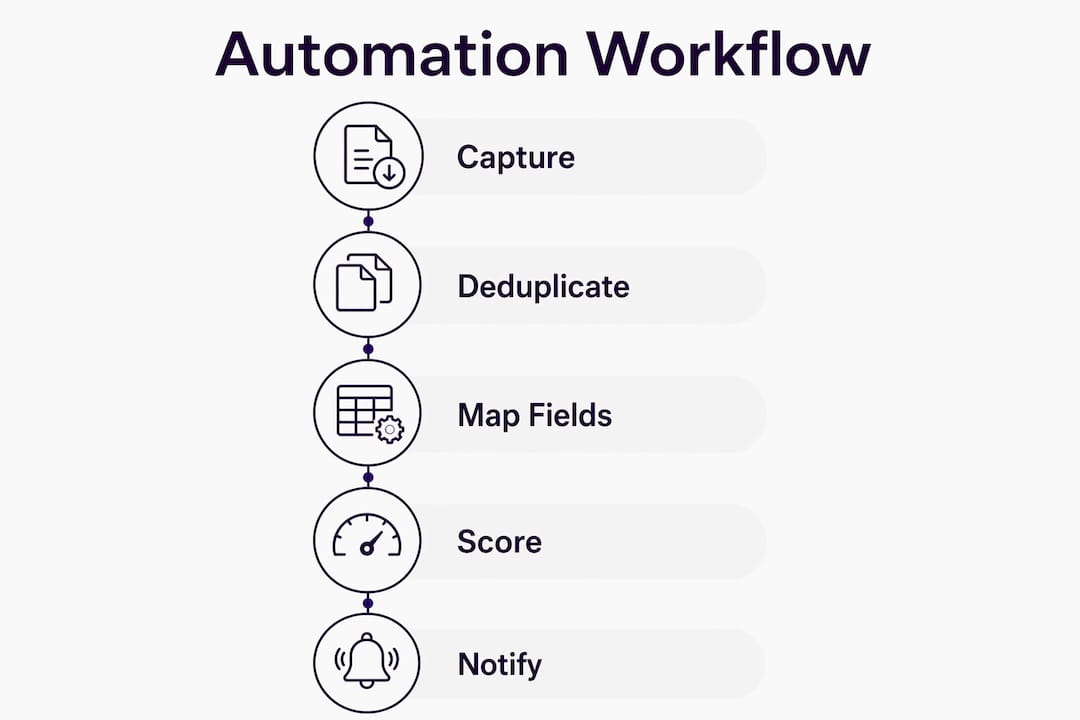
A well-designed workflow follows five steps in sequence: capture, deduplicate, map fields, score, and notify. Skipping any step creates downstream problems that compound over time.
| Workflow step | Primary benefit |
|---|---|
| Lead capture | Collects prospect data from forms, ads, chatbots, and calls in one place |
| Deduplication | Prevents duplicate CRM records that distort pipeline reporting |
| Field mapping | Standardises data format so scoring and routing work correctly |
| Lead scoring | Ranks prospects by conversion likelihood for sales prioritisation |
| Sales notification | Delivers instant alerts so reps contact high-intent leads within minutes |
A Zapier workflow captures form or Facebook Lead Ads submissions into a CRM within 60 seconds, with deduplication and notification steps built in. That 60-second window matters because lead response time is one of the strongest predictors of conversion.
Critical pitfalls to avoid
- Never test your workflow with real prospect data. Use dummy records so you do not accidentally trigger outreach to live contacts during setup.
- Always include a capture source field in your CRM record. Skipping deduplication can cause CRM data corruption and lost campaign performance insights. Without source attribution, you cannot tell which channel is producing your best leads.
- Do not route every lead directly to sales. Low-scored contacts should enter a nurturing sequence first, so reps spend time only on prospects who are ready to buy.
Duplication checks and capture source fields are critical for clean CRM data and accurate attribution. A CRM filled with duplicates and missing source data is worse than no CRM at all, because it gives you false confidence in numbers that mean nothing.
Pro Tip: Run a deduplication audit on your existing CRM before connecting any new automation. Garbage in, garbage out applies directly to lead scoring models.
How do you build a multi-layer AI lead generation system?
AI lead generation systems are best designed as layered frameworks with data, activation, and optimisation layers that share information to improve conversion continuously. Each layer has a distinct job, but they depend on each other.
Layer 1: Data consolidation
The data layer pulls signals from your CRM, website analytics, ad platforms, and third-party intent providers into a single unified view. Without this consolidation, each channel operates in isolation and your scoring model works with incomplete information.
Layer 2: Activation
The activation layer runs your paid ads, SEO content, social media posts, and local listings. For Ontario businesses, this includes Google Business Profile optimisation and geo-targeted ad campaigns that speak to local buying behaviour. Each activation channel feeds lead data back into the data layer.
Layer 3: Optimisation
The optimisation layer applies AI to test creative variations, reallocate budget toward top-performing channels, and personalise messaging based on prospect behaviour. Dynamic creative testing, for example, automatically serves different ad headlines to different audience segments and shifts spend toward whichever version converts best.
Sharing data across AI layers disrupts silos and achieves better lead scoring, routing, and budget allocation. The system learns from every interaction and gets more accurate over time.
- Start with the data layer. No activation or optimisation effort works well without clean, unified data.
- Connect your activation channels to a single reporting dashboard so the optimisation layer has full visibility.
- Review AI-generated budget recommendations weekly, not monthly. Markets shift fast and delayed reallocation costs conversions.
Pro Tip: Run a focused 30-day AI rollout: spend the first 10 days consolidating data sources, the next 10 days activating one or two channels, and the final 10 days reviewing optimisation signals before scaling.
Key takeaways
Lead generation automation delivers the strongest results when AI, compliance architecture, and clean workflow design work together as a single connected system.
| Point | Details |
|---|---|
| Define the full cycle | Automation must cover capture, deduplication, scoring, and notification to function as a complete system. |
| Build compliance into the architecture | Append-only consent logs and fail-closed verification gates prevent GDPR and TCPA breaches before they happen. |
| Use predictive scoring daily | Refreshing lead scores with current intent signals keeps sales teams focused on the highest-value prospects. |
| Deduplicate before you score | Clean CRM data is the foundation of accurate scoring, attribution, and pipeline reporting. |
| Layer your AI system | Data, activation, and optimisation layers must share information continuously to improve lead quality over time. |
What I have learned from building automated lead systems
James here. After years of working with Ontario businesses on marketing automation, the pattern I see most often is this: teams buy the tools, skip the architecture, and wonder why their pipeline is full of noise.
The compliance piece is where most businesses cut corners. They treat consent as a legal formality rather than a structural requirement. That works fine until a regulator or a prospect complaint forces a full audit. Building append-only consent logs from day one is not expensive. Rebuilding your system after a breach is.
The second mistake is expecting AI to fix bad data. Predictive scoring is only as good as the CRM records it trains on. I have seen businesses run sophisticated AI models on CRM data riddled with duplicates and missing fields, then wonder why the model's recommendations make no sense. Clean the data first. Always.
The insight that changed how I advise clients is this: automation is not a replacement for sales judgement. It is a filter. The goal is to make sure that when a sales rep picks up the phone, they are talking to someone who is genuinely ready to buy. That requires the full system: clean data, accurate scoring, instant notification, and a human who knows what to do with a warm lead. Start small, prove the model on one channel, then scale.
— James
How Dexcoretechnologies supports your lead generation automation
Ontario service businesses lose leads every day to missed calls and slow follow-up. Dexcoretechnologies addresses this directly with an AI receptionist for service businesses that answers calls 24/7, qualifies prospects in real time, and routes high-intent leads to your team with instant notifications.
The system integrates with CRM platforms and workflow tools, so every captured lead enters your pipeline with full source attribution and no manual data entry. Contractors, restaurants, and transport businesses across Ontario use Dexcoretechnologies' 24/7 AI answering to capture leads that would otherwise go to voicemail and never convert. Dexcoretechnologies reports a potential ROI of up to 942% for businesses that replace manual call handling with automated lead capture and routing.
FAQ
What does lead generation automation mean?
Lead generation automation is the use of AI and software workflows to identify, capture, score, and follow up with prospects without manual effort. It replaces repetitive sales development tasks with triggered, rule-based, and AI-driven processes.
What tools are used for automated lead generation?
Common lead generation automation tools include CRM platforms, workflow connectors like Zapier, AI chatbots, predictive scoring engines, and AI receptionist systems like those offered by Dexcoretechnologies. The right combination depends on your business size and the channels where your prospects are most active.
How does AI improve lead nurturing automation?
AI personalises nurturing sequences by analysing prospect behaviour and adjusting message timing, content, and channel in real time. Predictive scoring models trained on CRM data can triple conversion rates compared to static, rule-based nurturing.
What is the difference between GDPR and TCPA compliance in lead capture?
GDPR applies to prospects in the European Union and requires affirmative consent, audit trails, and data subject rights fulfilment. TCPA applies in the United States and governs phone and text outreach consent. Canadian businesses targeting both markets need compliance architecture that handles both frameworks simultaneously.
How quickly should a business respond to an automated lead?
Speed is critical. Automated workflows that deliver a sales notification within 60 seconds of lead capture give reps the best chance of connecting with a prospect while intent is highest. Delays of even a few hours significantly reduce conversion likelihood.